
This is my second take on this review. I’m posting a new version because I received emails from two readers who took me to task — persuasively — for my response to the script’s treatment of the main character’s intellectual disability. (You can read their comments below.)
As I’ve done here, I’ll render the significant changes in bold.
Spoiler alert: I haven’t changed my analysis, but I have, I hope, articulated it more clearly and generously.
There is a big heart and there are some strong theatrical instincts at work in Wonderwall. There are also problems with this script and production.
Local writer James Barclay’s play is about the friendship between a middle-aged guy named Peter, who lives with intellectual deficits caused by a car accident, and his young neighbour Charlotte, whose family is facing the loss of their home. Peter cuts lawns for neighbours. Charlotte convinces him to cut her in on the action.
Both Charlotte and Peter are lonely, and their growing connection made me tear up more than once. Barclay keeps things nicely concrete: Peter is often immersed in VR, for instance, staggering around the stage in his headset; the characters prep for Hallowe’en. The playwright also knows how to up the ante: Peter’s mom Anne, with whom he lives, has problems of her own, and Charlotte’s dad, Scott, is an alcoholic who’s gotten in too deep with criminals. Charlotte’s mom, Tina, is struggling to establish emotional and financial independence. These obstacles and complications are all good.
But there are also verisimilitude issues. We’re told that Charlotte is a teenager, for instance, but she thinks she can save the house with the money she plans to make doing yardwork, which is not a teenage thing to think.
Okay, here comes the biggest rewrite. In my original review, I complained about the play’s “cutesification” of intellectual disability and said that too much of the humour derived from Peter’s viewpoint isn’t “about the quirkiness of Peter’s perceptions; these are exploitive laughs about how stupid he is.”
That was overly harsh and I apologize to both readers and the artists involved for not thinking this through more thoroughly. Let me try again.
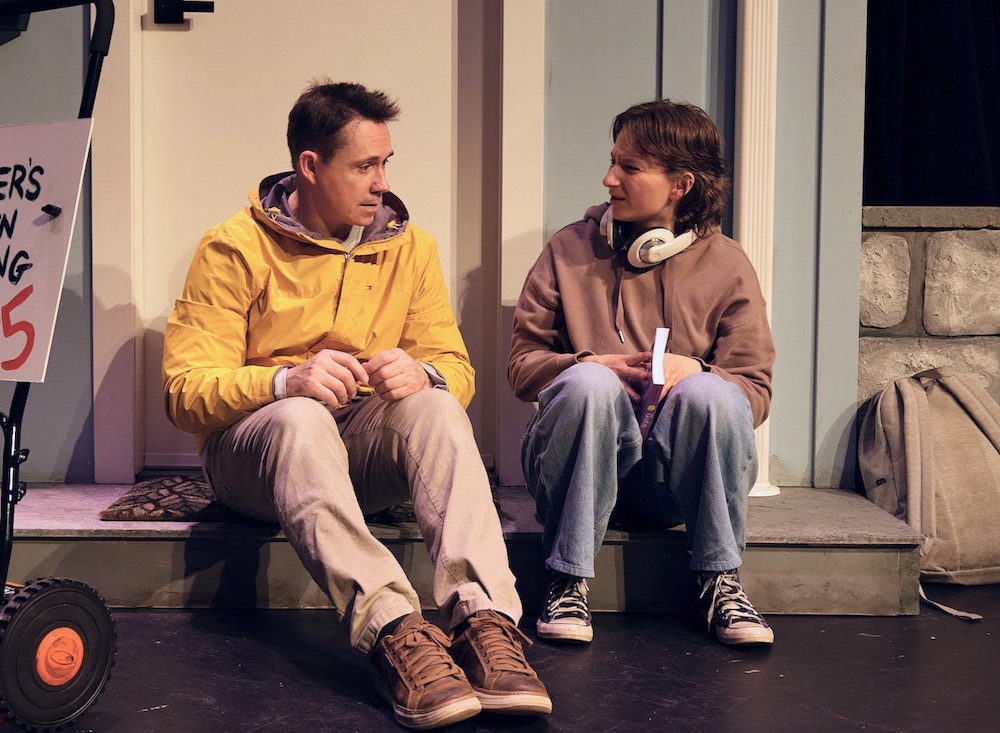
Barclay, the playwright, has also taken on the role of Peter and he delivers a tender, emotionally vulnerable, physically precise performance that includes great comic timing. At first, Peter’s mistakes and misunderstandings are charming in their literalness. But it’s not long before Peter’s talking about how dangerous it is to bend over in the shower in prison — and that joke turns into a running gag. I’m sure there’s no malice involved in this, but I do think this is a good example of how, in writing, intellectual disability can turn into a too-easy way to get laughs. It’s about us, as an audience, standing outside the disabled character’s experience and laughing at it. Laughing affectionately, yes, but the device is still a form of othering and it makes me uncomfortable. (For context, I had similar problems with Forrest Gump. Millions didn’t, which, I understand, makes me an outlier, but that’s my sense of it.)
Tracy Labrosse’s direction is uneven. Overall, there’s a strong sense of emotional investment from the cast, which is great, but there are also times when overacting seems to be the director’s rather than the performer’s choice. At its baseline, Marta Bilous’ characterization of Charlotte, for example, is distinguished by a touching combination of vulnerability and pugnacious self-defence. But then, out of nowhere, there will be a glaringly illustrative moment. Describing her role in the lawn-cutting business, Charlotte says, “I look all sweet and innocent and people will pay a lot more for that.” Bilous strikes a coy pose on “sweet and innocent” that’s at odds with the subtlety of the rest of her portrait.
There are also conceptual oddities. When Charlotte’s parents are fighting and she puts on headphones, the racket dims — for us, even we’re not inside Charlotte’s head.
The set, which was designed by Barclay and Labrosse, contains handsome elements — notably Charlotte’s front door — but it rambles across the stage. It needs more visual focus.
Playing Tina, director Labrosse is credibly warm and conflicted. And there’s a pleasing groundedness to Carrie Hunter’s Anne. But, playing Scott, the dad, Omer Aubin brings so little physical commitment to the stage, and his delivery of the dialogue is so slow and overworked, that his presence becomes a kind of energy sink.
As a playwright, Barclay gives us not one, not two, but three endings, which is at least one reversal too many. Did the final flip make me cry? Yes. But I also felt like I was watching a playwright who had set up an unwieldy plot thread (Scott’s criminal involvement) and who was taking corners on two wheels so he could get out of it. Big things happen in these reversals, but they happen so quickly that, to me, they feel underdeveloped.
The promise of Wonderwall isn’t completely fulfilled, but this is a relatively new script from a small, amateur company, and there’s a lot to like.
Thanks to the folks who challenged my original review, which I’ve left intact (other than copyediting corrections suggested by one of these two readers) below.
WONDERWALL by James Barclay. A Black Box Theatre Co. production directed by Tracy Labrosse. Running at The Nest until May 2.Tickets and information.
PHOTO CREDIT: Wonderwall features strong performances from James Barclay and Marita Bilous. (Photo by Dominique Labrosse)
THERE’S MORE! You can get all my current reviews PLUS curated local, national, and international arts coverage in your inbox FREE every week if you subscribe to Fresh Sheet, the Newsletter. Just click that link. (Unsubscribe at any time. Super easy. No hard feelings.) Check it out.
ORIGINAL REVIEW
There is a big heart and there are some strong theatrical instincts at work here. There are also problems with this script and production.
Local writer James Barclay’s play is about the friendship between a middle-aged guy named Peter, who lives with intellectual deficits caused by a car accident, and his young neighbour Charlotte, whose family is facing the loss of their home. Peter cuts lawns for neighbours. Charlotte convinces him to cut her in on the action.
Both Charlotte and Peter are lonely, and their growing connection made me tear up more than once. Barclay keeps things nicely concrete: Peter is often immersed in VR, for instance, staggering around the stage in his headset; the characters prep for Hallowe’en. The playwright also knows how to up the ante: Peter’s mom Anne, with whom he lives, has problems of her own, and Charlotte’s dad, Scott, is an alcoholic who’s gotten in too deep with criminals. Charlotte’s mom, Tina, is struggling to establish emotional and financial independence. These obstacles and complications are all good.
But there are also verisimilitude issues. We’re told that Charlotte is a teenager, for instance, but she thinks she can save the house with the money she plans to make doing yardwork, which is not a teenage thing to think.
But the biggest issue I have with Wonderwall is its cutesification of intellectual disability. Barclay, the playwright, has also taken on the role of Peter and he delivers a tender, emotionally vulnerable, physically precise performance that includes great comic timing. But, in the writing, Peter’s disability is used as an excuse for a lot of cheap humour, which I find condescending. At first, Peter’s mistakes and misunderstandings are charming in their literalness. But it’s not long before Peter’s talking about how dangerous it is to bend over in the shower in prison — and that joke turns into a running gag. Peter answers the phone because “Maybe it’s that prince from Nigeria.” This isn’t humour about the quirkiness of Peter’s perceptions; these are exploitive laughs about how stupid he is.
Tracy Labrosse’s direction is uneven. Overall, there’s a strong sense of emotional investment from the cast, which is great, but there are also times when overacting seems to be the director’s rather than the performer’s choice. At its baseline, Marta Bilous’ characterization of Charlotte, for example, is distinguished by a touching combination of vulnerability and pugnacious self-defence. But then, out of nowhere, there will be a glaringly illustrative moment. Describing her role in the lawn-cutting business, Charlotte says, “I look all sweet and innocent and people will pay a lot more for that.” Bilous strikes a coy pose on “sweet and innocent” that’s at odds with the subtlety of the rest of her portrait.
There are also conceptual oddities. When Charlotte’s parents are fighting and she puts on headphones, the racket dims — for us, even we’re not inside Charlotte’s head.
The set, which was designed by Barclay and Labrosse, contains handsome elements — notably Charlotte’s front door — but it rambles across the stage. It needs more visual focus.
Playing Tina, director Labrosse is credibly warm and conflicted. And there’s a pleasing groundedness to Carrie Hunter’s Anne. But, playing Scott, the dad, Omer Aubin brings so little physical commitment to the stage, and his delivery of the dialogue is so slow and overworked, that his presence becomes a kind of energy sink.
As a playwright, Barclay gives us not one, not two, but three endings, which is two reversals too many.
The promise of Wonderwall isn’t completely fulfilled, but this is a relatively new script from a small, amateur company. There’s still promise and that’s a good thing.
WONDERWALL by James Barclay. A Black Box Theatre Co. production. Running at The Nest until May 2. Tickets and information.
PHOTO CREDIT: Wonderwall features strong performances from James Barclay and Marita Bilous. (Photo by Dominique Labrosse)
THERE’S MORE! You can get all my current reviews PLUS curated local, national, and international arts coverage in your inbox FREE every week if you subscribe to Fresh Sheet, the Newsletter. Just click that link. (Unsubscribe at any time. Super easy. No hard feelings.) Check it out.




Hi,
Colin here. I received the email below from a sender identified as Flonkurt. They had trouble posting, so I am posting this for them.
CT
My husband and I attended Wonderwall without knowing much about the play. We were just in the mood for something up-lifting. As parents of a 37 year-old intellectually disabled man, I can tell you right now that what we saw on that stage was basically our son. It was so incredibly heartwarming for us to see someone represent our family dynamic, and in such a humorous and loving way. Our son is funny, silly, caring and at times says inappropriate things just like the character, Peter. Your job is to critique, but when you write that your biggest issue with the play is the “cutesification of mental disability” (it’s called “intellectual” disability, by the way), and that you find the humour condescending, it’s upsetting to people who ACTUALLY have a person in their life who walks, talks and says identical things as “Peter.” You’re not qualified to have an opinion on that, unless you yourself have a child with an intellectual disability. Regarding the ending you didn’t like, it was the best part of the play for us. At the show we attended, practically the entire theatre was in tears. We absolutely LOVED Wonderwall. It was leaps and bounds better than the majority of plays we see at the Arts Club. One final note, in your review, you refer to Peter as “Pete.” Not sure how you could get that wrong. They must say “Peter” fifty times in the play and it’s literally written on a sign on the stage.
This is my reply to Flonkurt:
Hi,
Thanks for writing!
I’m sorry you had difficulty posting your comment on my site. Another reader had a similar problem, so I’ll look into it. In the meantime, I’ll post your comment manually. That should work.
Thanks for pointing out my mistakes about “intellectual disability” and “Peter”. I’ll make those corrections and, in the comments, acknowledge that I’ve done so.
Thanks, too, for sharing your experience with your son.
All the best,
Colin
Hi,
Colin here again. I haven’t been able to contact the second reader who wrote to challenge this review. Since I don’t have his approval to quote him, I’ll quickly synopsize what he said.
He wrote that he and his wife had tickets to Wonderwall but, after reading my review, decided not to use them. Friends of theirs saw the show, however, and thought it was the best thing they’d ever seen. So this reader and his wife went back to Wonderwall and he, too, feels it’s the best play he’s ever seen.
He makes the point that there is no making fun of disability in the script and that he found the show deeply moving. He’s upset that my review might steer people away from it.