
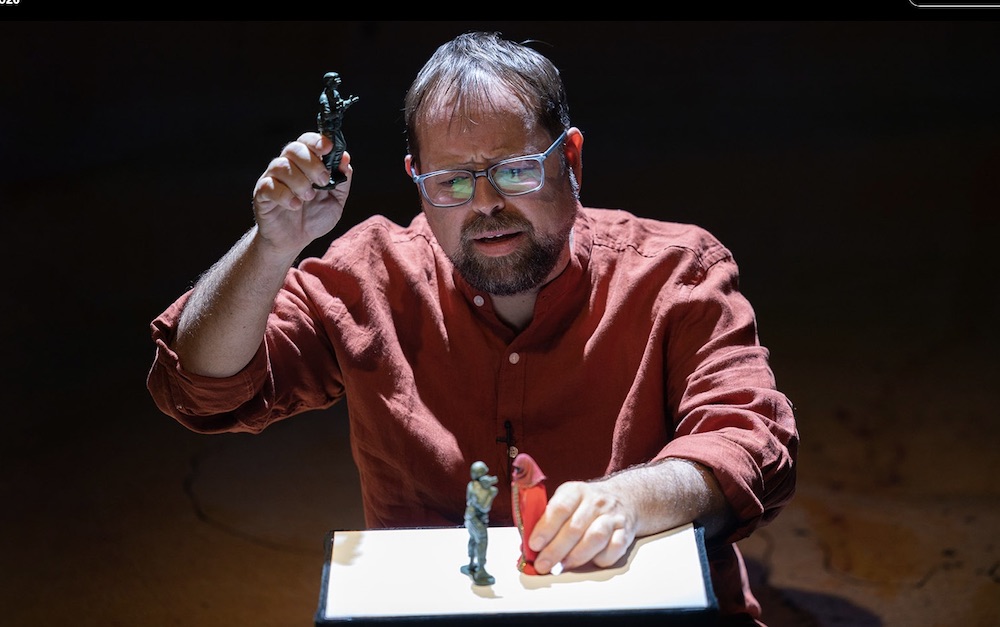
Okay, let’s talk about the art and let’s talk about the context, including the protests.
In Soldiers of Tomorrow, Israeli-born Vancouver theatremaker Itai Erdal tells the story of the political awakening he experienced during his three-year military service in the Israeli Defence Force when he was a teenager. Some pro-Palestinian folks have decided that they want to hear nothing about Israeli experience, so there have been protests outside The Cultch, where the play is being performed.
Two audience members I know were aggressively harassed on Thursday, when I attended the show. Approaching the theatre, I came across an encounter in which a local actor, who was also heading into the theatre, had been told that she must enjoy racist performances and was repeatedly being called “white trash” by one of the protesters. Inside, I ran into another theatre artist, who was also clearly shaken because, he explained, a different protester had been yelling in his face and telling him he should be ashamed for attending. In fairness, not all those protesting were being this aggressive, but the group as a whole was handing out folded fliers on which the first page reads, “Would Nazis have been given sympathy and a platform? No tears for the occupiers!”, neatly — and mistakenly — accusing Erdal of Nazi-like crimes or sympathies. (Let’s not forget that this artist is not the Israeli state, his time in the army notwithstanding.)
The Cultch staff is doing a superb job of handling the action outside the theatre, gently defusing situations when they threaten to erupt and checking in with people who could maybe use a check-in. I am not telling you about the protests to discourage you from attending Soldiers of Tomorrow. Quite the opposite in fact. (As I write this, there are still some tickets available for performances on May 9 and 10.) I don’t believe there’s any real danger involved in going to this show and I strongly believe it’s important not to let intimidation silence theatrical discourse. So, for those who feel up to it, going to the theatre in situations like this becomes an important form of activism in support of freedom of expression. I was surprised by how proud I felt of everybody who ran the short gauntlet and made it into The Cultch.
And let’s flash this in neon: Soldiers of Tomorrow is clearly and explicitly critical of Israel’s racist and genocidal policies and actions. The show is in solidarity with the people of Palestine. What the protesters are missing, what they are apparently unable to perceive through their understandable fury, is that there are potential allies standing right in front of them. That’s a huge loss — and, I would argue, a time-wasting distraction — of a type that’s all too common in our fiercely siloed times.
Okay, the art. The script, which Erdal wrote with playwright Colleen Murphy and with dramaturgical input from director Anita Rochon, is a confession: in Soldiers of Tomorrow, Erdal celebrates his fond memories of growing up in Jerusalem. He also explores his growing understanding of his own, culturally created racism and the problems of his early identification with — and understanding of — the state of Israel.
He talks about how he was “brainwashed and lied to” by his Israeli education, which conveniently ignored or glossed over the realities of the Nakba, for instance, the ethnic cleansing of Palestinians that started with the expulsion of 750,000 Palestinian Arabs in 1948. The Nakba also includes the ongoing persecution and displacement of Palestinians. As Erdal says in Soldiers of Tomorrow, without excusing the horrors of the day, “By October 7, 2023, Israel had created the largest outdoor prison in the world” in Gaza.
But, as a young soldier, Erdal was blind to all this — and that’s what haunts him.
In the most telling and theatrically successful scene, Erdal recreates — using toy soldiers and a small female figurine — an encounter he and some fellow members of the IDF had with an old woman at a checkpoint in Gaza. She wants to re-enter Israel with her very sick infant grandchild. The wary soldiers resist. When Erdal touches the burning forehead of the sick child, he realizes that, although he has always paid lip service to the principle of equality, he has never dared to understand what that might mean in his homeland.
The set, a large backdrop painted by designer Brian Ball, is an abstracted, freeform map of the region. In its gestural abstraction and the warmth of its colours, it’s beautiful. The music, which was written by and is performed by Vancouver-based Iraqi artist Emad Armoush, evokes all sorts of feelings: apprehension, mourning… And there are striking moments of physical theatricality, including a sequence that becomes a kind of death march for hundreds of tiny toy soldiers who seem to represent the soldiers sacrificed to the war, the (predominantly Palestinian) citizens murdered in the war, the victims of October 7, and the victims of the Holocaust.
All this said, I was more engaged when I watched a videotaped performance of Soldiers of Tomorrow recently. That’s probably partly because this was my second time seeing most of the material. But Erdal seemed to be having a bit of an off night on Thursday, when I attended. He juxtaposed words a few times, which indicates to me that he was reciting his text, as opposed to doing the actor’s job, which is to discover the text. He delivered almost all of it in the same tone and at the same clipped pace, so huge turning points, including when he said that a right-wing settler’s assassination of Israeli prime minister Yitzhak Rabin “broke my spirit”, failed to register with the force they warrant. As a result, this performance of Soldiers of Tomorrow felt too much like a lecture to me.
Still, Erdal is a confident, affable, and sincere presence, which goes a long way. I applaud him and his collaborators for creating this piece, and I applaud The Cultch for their courage in presenting it.
There are discussions after the show every night. On Thursday, the last audience member to speak was a former elementary-school teacher from Kamloops, who talked about how, because the reality of residential schools had been suppressed, she taught false history to her students — and about how she saw the ramifications of similar cultural lies in Soldiers of Tomorrow.
There you go: reflection, solidarity. That’s what it’s all about.
SOLDIERS OF TOMORROW by Itai Erdal with Colleen Murphy. Directed by Anita Rochon. An Elbow Theatre production presented by The Cultch. Running in The Cultch’s Historic Theatre until May 10. Tickets and information.
PHOTO CREDIT: (Itai Erdal in Soldiers of Tomorrow. Lighting by Alan Brodie. Photo by Matt Reznek.)
THERE’S MORE! You can get all my current reviews PLUS curated local, national, and international arts coverage in your inbox FREE every week if you subscribe to Fresh Sheet, the Newsletter. Just click that link. (Unsubscribe at any time. Super easy. No hard feelings.) Check it out.


“going to the theatre in situations like this becomes an important form of activism in support of freedom of expression” – so true, and so unfortunate, that art has been reduced to more of the us vs them polarity overwhelming out world. Ai Wei Wei said “Everything is art. Everything is politics.” As art and theatre lovers, let’s keep our minds open to new experiences, even if we don’t always agree with each other.
Hi Colin,
At the end of your review of Soldiers of Tomorrow there’s a place for comment. I was unable to send it, so I’m responding to your email as invited:
I agree that the use of trauma in art can look forward to the future or backwards through the rear-view mirror. The question that you bring up also transcends artistic expression and is the very reason we have come to this terrible impasse about Israel. The former victim becomes the victimizer as if ordained by their terrible suffering. Such was happening in the protest against Erdals’s play; the protester was behaving unconsciously (if not unconscionably).
I want to share a small passage from my just completed memoir, Out of the Fire, wherein, at the age of four, I had been sexually assaulted by a Holocaust survivor:
I never told my parents about what the man had done to me, but a palpable memory sits inside. What happened to this man in Auschwitz, Dachau, Buchenwald, or wherever he was taken and from which he was supposedly liberated? The mass atrocity hung over the neighbourhood like the Angel of Death. Innocent victims, survivors and their offspring were violated by the atrocity; the offspring, the children, victimized others, passing it on to the next generation and then to the next. This never ending cycle leads to one of the great existential questions of our times: Do you turn the damage into evil and revenge or do you turn it toward the light and the good?
Ken