
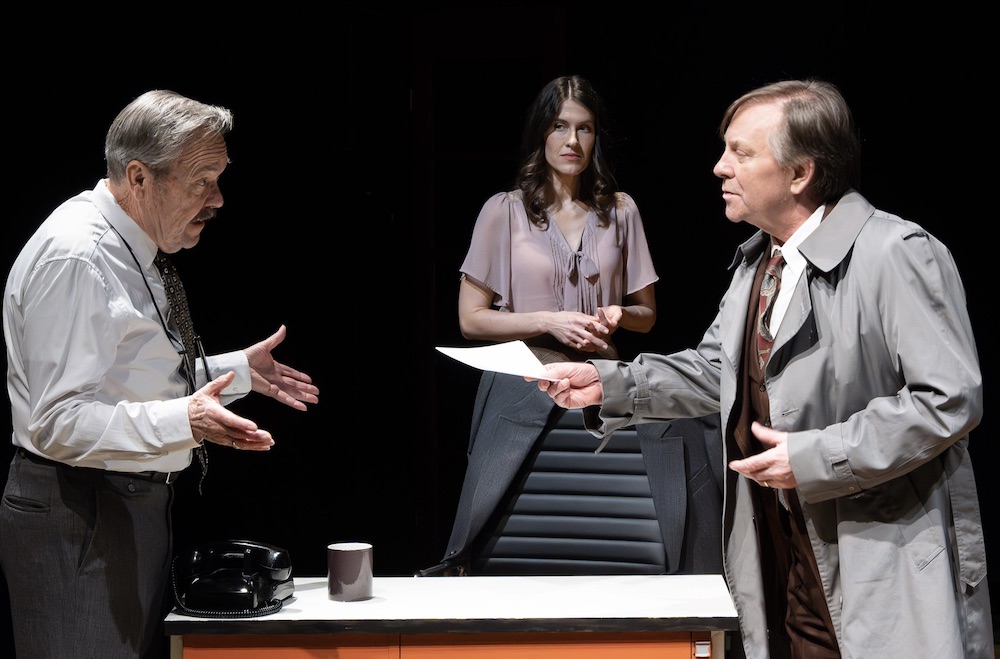
I’m so much angrier now than I was when I first saw the movie Network — which is all about anger — in 1976. Many of us these days live in a perpetual state of political fear, frustration, and fury, which makes United Players’ decision to produce playwright Lee Hall’s 2017 stage adaptation of Paddy Chayevsky’s screenplay an excellent choice.
If you don’t remember protagonist Howard Beale’s rallying cry “I’m mad as hell and I’m not going to take it anymore!”, let me fill you in.
At the beginning of the story, Beale has just been given notice that he’s about to get fired from his job as news anchor for the TV station UBS, a position he’s held for 25 years. On air, Beale announces that he will commit suicide on the following Tuesday’s newscast — and ratings go way up. That sparks a tug-of-war between news-division head Max Schumacher, who wants to get his longtime friend Howard, who’s clearly having a breakdown, off the air, and programmer Diana Christiansen, who wants to ride those ratings for all they’re worth.
Howard begs Max to give him an opportunity to make a dignified apology for his suicide threat — “I don’t want to go out like a clown” — and Max acquiesces. But, when Howard gets back on air, he goes off script and starts to rant about how the news is bullshit, life is bullshit, God is bullshit… He goes on to rally viewers to open their windows and yell into the street, “I’m mad as hell and I’m not going to take it anymore!” In the millions, they do.
Thrilled, Diana offers to help Max develop Howard’s attention-getting crazy-prophet persona. Max declines, but he starts an affair with Diana.
The dramatic stakes are high. And Network is packed with analysis that was prescient in 1976 and is ringing very loud, last-alarm bells today.
Thematically, Network is about capitalist control of the cultural narrative — through the medium of television — and the erosion of democratic agency.
In 2026, capitalism is playing its hand flagrantly. Former reality-TV star Donald Trump publicly threatens television networks, stations, artists, and programs. Trump and other colluding billionaires are staging a rolling media coup d’état: Zuckerberg, Musk, Bezos, Ellison…
So, yeah, I’m mad as hell and it felt therapeutic to yell that out — in like-minded company — when the audience was encouraged to do so.
Under Kathleen Duborg’s direction, this production is strong.
A couple of caveats before we get into that. Gordon Law, who’s playing the self-serving TV exec Frank Hackett is mangling his important character’s lines with his arbitrary changes in volume and rhythm. Law is working too hard and too self-consciously; he needs to just spit things out.
This next comment might seem disrespectful. I don’t mean it as such. I’m going to make it because I think it’s relevant. Tom McBeath is miscast as Max: he’s too old for the role. I am not knocking McBeath’s performance: as Max, he delivers a nuanced and credible rendition of the character’s emotional fatigue and desperation. But it’s not credible when Max and Diana both refer to Max as a “craggy middle-aged man.” (McBeath has several years on me and I’m 73.) There is an age gap between Max and Diana, as written, but, when that gap is as big as it is here — and the size of that gap goes unacknowledged and unexplored — it undermines the erotic charge that’s the lifeblood of the Max/Diana plotline. (Yes, there can be an erotic charge in relationships where there are gaps of 40 or 50 years but, to make that charge compelling, you’d have to be upfront about it.)
I would like to have seen more ruthlessness from Alison Wandzura’s Diana. Still, Wandzura delivers a consistently clear and intelligent characterization that’s internally alive.
At the centre of this Network, David Marr’s Howard is touchingly innocent. In Marr’s hands Howard’s inchoate denunciations of politics-as-usual are exhilarating. And, importantly, Marr knows how to play the comic rhythms.
Mathilde Shisko makes a strong impression as Louise, Max’s heartbroken and furious wife of 25 years. Kyle Mitchell Swanson also stands out for his snaky condescension as Arthur Jensen, a character who speaks in the pure voice of capitalism — and who’s dressed like Steve Jobs in this production.
There’s a group effort here, a shared commitment from everyone in the ensemble, that powers the production. And Duborg paces it well.
Emily Dotson’s cinematic set takes up every square inch of the Jericho Arts Centre’s vast playing area. I appreciate its levels, its painted floor (like a test pattern), and its stylish, flexible set pieces.
I also enjoyed this production’s playful and effective use of film (directed by Missy Cross) and video (directed by Nick Lowin).
I love 70s fashion and costume designer Julie White goes for broke with it, especially in a series of outfits worn by Sophie Mildiner, who’s playing several secretaries.
Thanks to UP’s artistic director Sarah Rodgers for programming such a politically relevant piece, and to Duborg for delivering such an engaging production.
NETWORK , adapted for the stage by Lee Hall, based on the screenplay by Paddy Chayefsky. Directed by Kathleen Duborg. A United Players production. Running at the Jericho Arts Centre until April 12. Tickets and information.
PHOTO CREDIT: (Photo of Tom McBeath, Alison Wandzura, and David Marr by Nancy Caldwell)
THERE’S MORE! You can get all my current reviews PLUS curated local, national, and international arts coverage in your inbox FREE every week if you subscribe to Fresh Sheet, the Newsletter. Just click that link. (Unsubscribe at any time. Super easy. No hard feelings.) Check it out.




0 Comments