
In the theatre, style is one of the trickiest things to get right.
This United Players production of George Bernard Shaw’s Arms and the Man is hit and miss, which is a good thing in a way: it helps to clarify what works and what doesn’t when approaching Shavian comedy.
In its mechanics, the play, which was first produced in 1894, owes a lot to farce.
It’s set in 1885 during a brief (and real) war between Bulgaria and Serbia. After a military rout, a fleeing Serbian officer named Captain Bluntschli climbs a rainspout and finds himself in the bedroom of a wealthy young woman named Raina Petkoff. When Bulgarian soldiers arrive, hot on Bluntschli’s trail, Raina takes pity on Bluntschli and hides him behind the curtains on her bed. This is pure farce. Raina gets her mother, Catherine, in on the deception, which leads to more farcical complications — misplaced notes, sudden plot turns, and so on.
But then Shaw adds a whole other level of spin: social commentary, often in the form of satire, with the concepts of heroism and romantic love, as well as the unfairness of the class system as the primary targets.
Raina believes that her sweetheart Sergius is a hero because he led a successful cavalry charge, but Bluntschli, the more experienced soldier, informs Raina — persuasively — that Sergius is an idiot who should be court martialed. Sergius sexually targets Louka, the Petkoffs’ maid, who responds with fierce class analysis.
So how do you play this script? How do you play these characters? This comedy. If Arms and the Man were a pure farce, you might lean into comic types and caricatures. But that would do a disservice to the script’s more fundamental project, which is substantial social commentary. The most interesting characters in Arms and the Man — and, therefore, those upon whom the stylistic baseline should be set — aren’t broad clowns, they are characters who have misplaced ideals. And, as I see things, that difference should lead you to a subtler performance style.
According to the terms I’ve just laid out, three of the actors in director Lauren Taylor’s production are doing a great job. Two of them are quite obviously articulating Shaw’s politics. As Bluntschli, Jay Clift is the humble, charming voice of reason, who calmly dismantles the illusions of heroism. In his smart, amiable performance, Clift gets the tone exactly right. And Kiyomi Hoover’s Louka is the most compelling figure on the stage: there’s no ignoring her vulnerability, her fury, or the force of her argument. I also particularly enjoyed Victor Vasuta’s work as Louka’s betrothed, the Petkoff family’s other servant, Nicola. Nicola takes a pragmatic approach to the class struggle, so he creates fewer thematic fireworks, but, as with actors Clift and Hoover, I appreciated the simplicity and authenticity with which Vasuta went about getting the job done.
Under Taylor’s direction, Hannah Everett overacts Raina’s girlish romanticism, but she finds her feet in the later going. (I do understand that there’s a transition written into the script; my take is that the contrast needn’t be so stark.)
Lauren (Kirsten) Robek overacts as Raina’s mother Catherine and Raphael Kapinski overacts — on one, loud note — as Raina’s father Paul. Playing Sergius, Raina’s sweetheart, Brandon James Gilbert starts to holler after the intermission in this production, and he keeps on hollering for a long time. That’s a shame because I got the sense that, underneath the volume, Gilbert knew what Sergius was talking about.
Stylistic consistency is a big part of the director’s job. Taylor needed to keep a tighter rein on things.
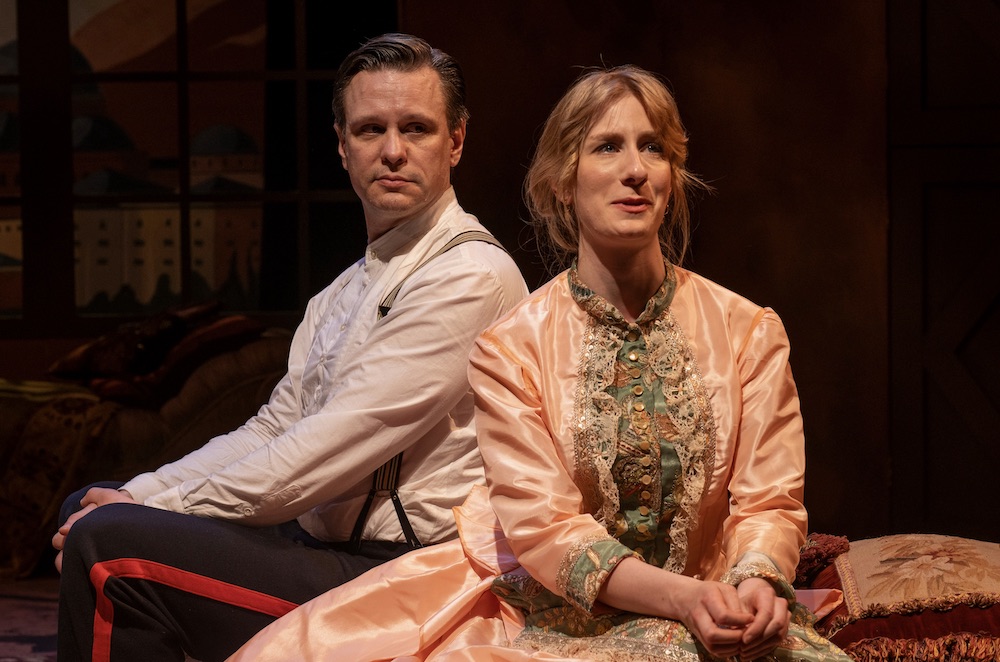
Brodie Davison’s period costumes, especially the women’s dresses, with their lavishly embellished hems, are handsome.
Pre-intermission, this production is a bit of a haul. After the break, the plot tightens up and the strengths of this mounting start to pay off.
ARMS AND THE MAN by George Bernard Shaw. Directed by Lauren Taylor. Produced by United Players of Vancouver. At the Jericho Arts Centre until June 21. Tickets and information.
PHOTO CREDIT: (Photo of Jay Clift and Hannah Everett by Cameron Clark Anderson. Costumes by Brodie Davison)
THERE’S MORE! You can get all my current reviews PLUS curated local, national, and international arts coverage in your inbox FREE every week if you subscribe to Fresh Sheet, the Newsletter. Just click that link. (Unsubscribe at any time. Super easy. No hard feelings.) Check it out.




Colin you got my name wrong in the body of your review but it is correct in the caption of the photos
Dang! Thanks for letting me know, Brodie. I’ll change that right now.