
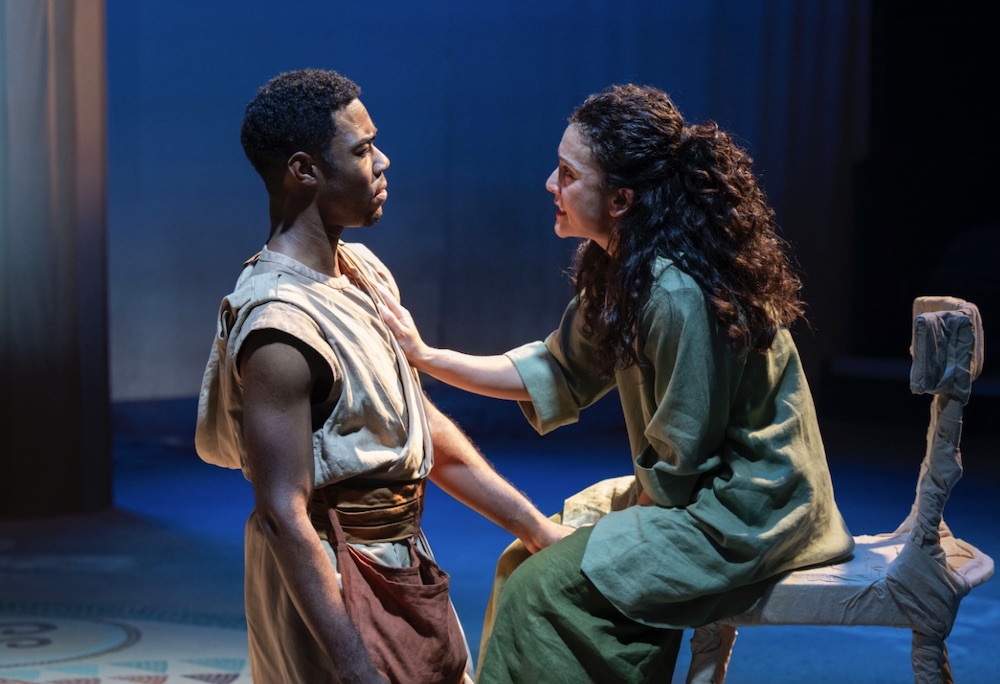
Kate Besworth’s treatment of Antigone by Sophocles is more than an adaptation, it’s a substantial rewrite. And it has its strengths: Besworth’s script is trim and it knows what it wants to do; several original scenes resonate and the complete reimagination of one of the main characters is surprisingly moving. On the other hand, Besworth has narrowed the philosophical scope of the original.
Some context for my opinions: I am not a scholar of Greek drama, and I have yet to see a straight-ahead production of Antigone. I’ve constructed my conceptual framework largely from my understanding of Robert Fagles’s translation of the script (which is a very good read, by the way), his introduction to The Three Theban Plays, and critic Helen Shaw’s essay, “The 2,500-Year-Old Heroine Whose Story Never Gets Old” in The New York Times. (Shaw is a scholar of Greek drama who has a particular passion for Antigone.)
To get the original story straight: Antigone and her sister Ismene are the last surviving members of a cursed family. Unwittingly murdering his father Laius and committing incest with his mother Jocasta, their father Oedipus fulfilled a prophecy. When Jocasta realized this truth, she committed suicide. By the beginning of Antigone, Oedipus has also died, and, in a war over the control of Thebes, Antigone and Ismene’s brothers, Eteocles and Polynices, have recently murdered each other.
Now Antigone’s uncle Creon, the new king of Thebes, has given Eteocles, who defended the city from his brother’s attack, a hero’s burial, but he has left the corpse of Polynices, whom he considers a traitor, to rot outside the city gates — and declared that anyone who attempts to bury Polynices, or even mourn him, will be executed.
Antigone is openly defiant in her determination to bury her brother. The play is a dialectic between Antigone’s insistence on “natural order”, her personal sense of fundamental moral values, and Creon’s championing of civic order, including the shared laws that keep chaos at bay.
By heavily favouring Antigone, Besworth undermines this essential tension. In the original script, the Chorus, which is an intermediary for the audience, sides with Creon. It isn’t until the king openly defies the gods and a message they’ve sent through the Delphic oracle that the Chorus’s sympathies shift towards Antigone.
This original script allows us to see Antigone and Creon as avatars of realities that overlap, including in their dark sides. Creon eventually reveals himself as a Trump-like autocrat: “The city is the king’s. That’s the law.” And Antigone is a zealot in love with death. (In Fagles’s translation, there’s a heavy erotic charge to her fixation.) In her self-righteous certainty, one might see Antigone’s similarity to the smugness of some on today’s left.
In the original, the Chorus calls for a blending of Creon and Antigone’s positions: “When he [mankind] weaves in the laws of the land and the justice of the gods, that binds his oaths together and his city rises high.” In Besworth’s rewrite, the Chorus begins by summoning Antigone, asking who can save them, and concludes by celebrating her like a cheerleading squad: “Say her name! Let it mean something! Antigone! Antigone! Antigone!”
As a result, the moral complexity of the original is largely lost and so is the potential for the drama that could have been provoked by the shift in audience sympathies.
But Besworth is hunting other game. Her Antigone champions the female and the feminine, an approach her heroine makes explicit when she says, “I really only believe in the female gods.”
This strategy yields some surprising changes.
Jocasta, for one thing, is still alive, which makes for a more fulsome centering of female experience as Antigone seeks and fails to find solidarity with her mother as well as her sister. This is particularly touching when a doomed Antigone refuses her mother’s offer of a last embrace.
Jennifer Lines is playing Jocasta here, and this actor’s easy access to emotional depth helps Jocasta’s scenes to land.
I would also include in Besworth’s feminizing strategy her rewrite of the character Haimon. In the original, Haimon, who is Creon’s son and Antigone’s betrothed, is a strong and articulate voice of reason. In Besworth’s reimagining, Haimon is sensitive to the point of neurological divergence. Besworth’s Haimon is attuned to the feelings of his horses. And he has developed a reliable sense of self that’s entirely dependent on his experience of Antigone’s love.
In centering the strength of one female character, Besworth has made a significant male character appealing in his weakness: compellingly embodied by actor Cameron Grant, Haimon’s vulnerability becomes one of the most moving elements of this production.
As performed by playwright Besworth, on the other hand, Ismene is played for laughs to a surprising degree. She becomes a foolish teenager with little dramatic weight and that’s a loss.
Fortunately, Yoshie Bancroft’s Antigone is frank, unadorned, simply, commandingly present.
And Paul Moniz de Sá bring the requisite authority to Creon, which helps his scenes with Antigone and Haimon to fire.
The robes provided by costumer Jessica Oostergo are lovely in their simplicity. And John Webber’s lighting design supports the storytelling, notably in a cue near the end, when Antigone has been entombed and is awaiting her death.
I stayed with this production. Several elements struck home. And I wish Besworth hadn’t so clearly played favourites.
ANTIGONE Adapted from Sophocles’s original by Kate Besworth. Conceived by Kate Besworth and Ming Hudson. Directed by Ming Hudson. A Bard on the Beach production running in rep in the Douglas Campbell Tent at Bard on the Beach until September 18. Tickets and information.
PHOTO CREDIT: This photo of Cameron Grant as Haimon and Yoshie Bancroft as Antigone is by Emily Cooper. Costumes: Jessica Oostergo. Lighting: John Webber.)
ACTIVATE YOUR FREE SUBSCRIPTION TO THE FRESH SHEET NEWSLETTER AND GET MY LATEST REVIEWS — PLUS ESSENTIAL GLOBAL ARTS COVERAGE — STRAIGHT TO YOUR INBOX EVERY WEEK. UNSUBSCRIBE ANYTIME.



0 Comments