
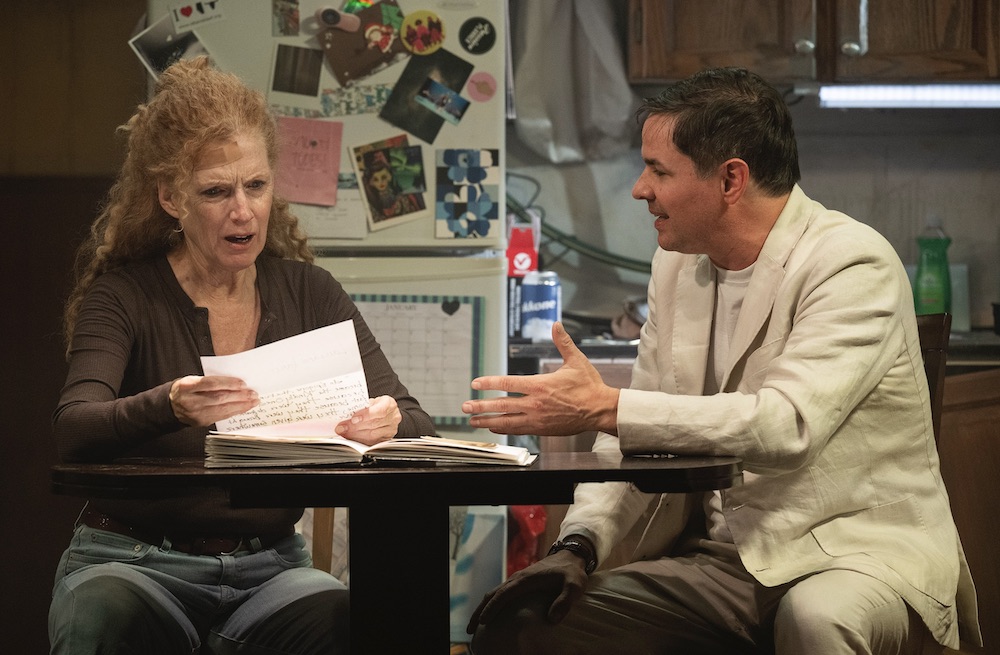
I loved being in it. Keven Kerr’s play is so unpredictable — narratively and stylistically — I never knew what was going to happen. And, working with the show’s designers, director Jonathon Young’s mounting of the piece is so immersive that watching it is like being in the middle of a sound-and-light installation.
The content is substantial: James has driven north to clear out his sister Laine’s trailer after her death from a drug overdose.
But let’s start with Paula Viitanen Aldazosa’s set. It’s a three-dimensional chunk of the trailer, by which I mean you walk around it as you enter the performance space, past the front door through which characters will enter and exit later on. The trailer has three walls and a low-hanging ceiling, which creates claustrophobic forced-perspective. And it’s so filthy — disturbingly, recognizably so — that you can almost smell it.
Even before the show starts, crows caw and dogs bark — all around you — in Kate De Lorme’s sound design.
And, when the action kicks into gear and the play’s realities start to slide between naturalism and myth, the shifts are accompanied by lighting and video designer Eric Chad’s destabilizing cues: the red and blue emergency flashers that transform the space; the TV set, which has a mind of its own, telling us about the crows who become escorts to the dead.
All of this is in clear service of and alignment with Kerr’s ambitious, slippery script. In his program notes, the playwright tells us that, in 2021, during the height of Covid, his sister “became another victim of the increasingly toxic drug supply.”
“Unable to navigate the spiritual rites that mark the transition between the world of the living and the realm of the dead” following that death, Kerr turned to Sophocles’s Antigone, in which the title character insists on a respectful burial for her outcast brother Polynices. While Epigone is “very much a work of fiction and imagination”, Kerr says, “it has been a collaboration with my sister, Tricia.”
In Epigone, the guide to the mythic world arrives in the form of a young relative named Angela. A denier of Covid science, Angela is also a midwife and death doula who has firm beliefs about the importance of rituals. Epigone’s rituals are about guilt, shame, and responsibility.
The performances are excellent. When Colleen Wheeler shows up as Laine’s nearby neighbour Karen, there’s so much depth to her performance it’s like the trailer suddenly acquires a basement and several new rooms. Wheeler has the voice to make this happen. Her lower register, in particular, is so compelling that it sounds like her Karen is speaking Shakespeare.
All the performances are on point: the white-hot protectiveness and defensiveness of Kevin MacDonald’s James; the frank otherworldliness of Lili Beaudoin’s Angela; and the combination of weakness and bravado that Tom McBeath brings to Laine’s would-be lover Stormy.
Act 2’s perspective shifts in a way that I’ll leave to you to discover. I will say, though, that it spends more time in the naturalistic world and its excursions into alternative realms feel somewhat deliberate and tidy. But this is all in the admirable context of paying respect to those who struggle with addiction, mental illness, and poverty, and there’s some moving content here.
Thematically and stylistically, Epigone is almost uniquely ambitious, and it’s so thoroughly well realized in this production that it’s a pleasure to sink into.
EPIGONE by Kevin Kerr. Directed by Jonathon Young. An Electric Company Theatre production presented by the Downtown Eastside Heart of the City Festival. At the Russian Hall (600 Campbell Street) until November 15. Tickets and information.
PHOTO CREDIT: (This photo of Colleen Wheeler and Kevin MacDonald is by David Cooper. Set: Paula Viitanen Aldazosa. Costumes: Donnie Tejani. Lighting: Eric Chad.)
ACTIVATE YOUR FREE SUBSCRIPTION TO THE FRESH SHEET NEWSLETTER AND GET MY LATEST REVIEWS — PLUS ESSENTIAL GLOBAL ARTS COVERAGE — STRAIGHT TO YOUR INBOX EVERY WEEK. UNSUBSCRIBE ANYTIME.




0 Comments