
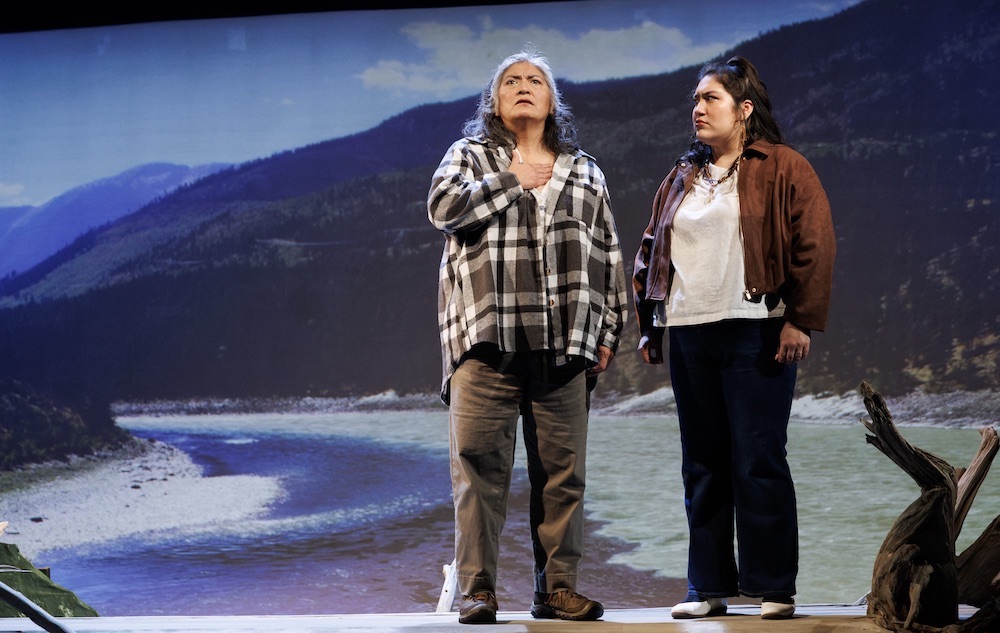
Kevin Loring’s Where the Blood Mixes explores the aftershocks of the residential-school system in one father/daughter relationship. I first saw this script at its premiere on June 11, 2008, the same day that Prime Minister Stephen Harper issued a formal apology in Parliament for the profound damages caused by that system. In the broader culture at least, there hadn’t been a lot of talk about residential schools, and the impact of the show was electric. Where the Blood Mixes went on to receive multiple honours, including the Governor General’s Award for Drama.
From my settler perspective, more than 18 years later, the script is, understandably, showing its age in some ways. In other — substantially important — ways, it’s not.
Eighteen years ago, there was more of a sense of discovery (for me) in encountering the script. I experienced significantly less discovery in Act 1 this time around.
We meet Floyd and his friend Mooch as they drink beer and buy pull-tab lottery tickets in the pub at the Lytton Hotel, watched by George, the settler bartender. To fund his alcoholism, Mooch has been stealing from his partner June, and she shows up occasionally to lay into Mooch physically and drag him home.
We also meet Christine, who was taken into government care when she was little — sometime after the death of her mom — and eventually adopted. There are evocative moments in which Christine writes to Floyd to say she wants to meet him, and he agrees.
Mostly though, Act 1 is an evocation of place. I suspect that, the first time around, I was hungrier for representations of Indigenous experience. That representation has increased notably since then so, in the first act, I found myself longing for more than an evocation of place. I wanted to get to the storytelling.
On that front, Act 2 delivers. Christine shows up in Lytton, and her presence ignites multiple crises. Will Floyd be able to speak openly to her? Will Christine be able to accommodate Floyd’s failures? Will Mooch succumb to despair? With all these questions, with all this plot development, in 2026, Act 2 is much more engaging than Act 1. And, given ongoing anti-Indigenous racism, including residential-school denialism, and relentless bureaucratic disrespect (the lack of clean drinking water on reserves, inadequate health care for folks on reserves, the likely bulldozing of Indigenous rights for “projects of national interest”), the thematic weight of Where the Blook Mixes remains substantial.
Under the direction of playwright Loring, this physical production is beautifully tailored all the way through. In Candelario Andrade’s video design, a sturgeon slithers, projected onto a gigantic log that’s part of Ted Roberts’s evocative, quasi-realistic set. Jeff Harrison’s lighting floods the floor. In Troy Slocum’s excellent, detailed sound design, we hear the perfectly timed ticking of Floyd’s fishing line as he casts it out and, moments later, the faint whistle of a train in the distance.
Throughout, the performances are strong. Jonathan Fisher explores all the crevices of Mooch’s character, including his well-timed, perky clownishness, his shard-like brokenness, and his resiliency. In Act 1, Danica Charlie is especially moving when she slips into the persona of Christine as a little girl. And Trevor Duplessis’s Floyd is a pleasing combination of intelligence, shame, good intentions, and irony.
Under Loring’s direction, the performance of the play’s emotional climax feels somewhat overwrought to me, as if the actors are reaching for their tears, but I might be misinterpreting a cultural sensibility, and I certainly never questioned the legitimacy of the characters’ sorrow.
Ultimately, that sorrow lands. And, in complicated ways, the script’s hope endures.
WHERE THE BLOOD MIXES Written and directed by Kevin Loring. A Firehall Arts Centre production in association with Savage Society. Running at the Firehall Arts Centre until December 6. Tickets and information.
PHOTO CREDIT: (This photo of Columpa Bobb as June and Danica Charlie as Christine was taken by Sarah Race Photography. Projection design: Candelario Andrade. Costumes: StarLynn Chen.)
ACTIVATE YOUR FREE SUBSCRIPTION TO THE FRESH SHEET NEWSLETTER AND GET MY LATEST REVIEWS — PLUS ESSENTIAL GLOBAL ARTS COVERAGE — STRAIGHT TO YOUR INBOX EVERY WEEK. UNSUBSCRIBE ANYTIME.

0 Comments