
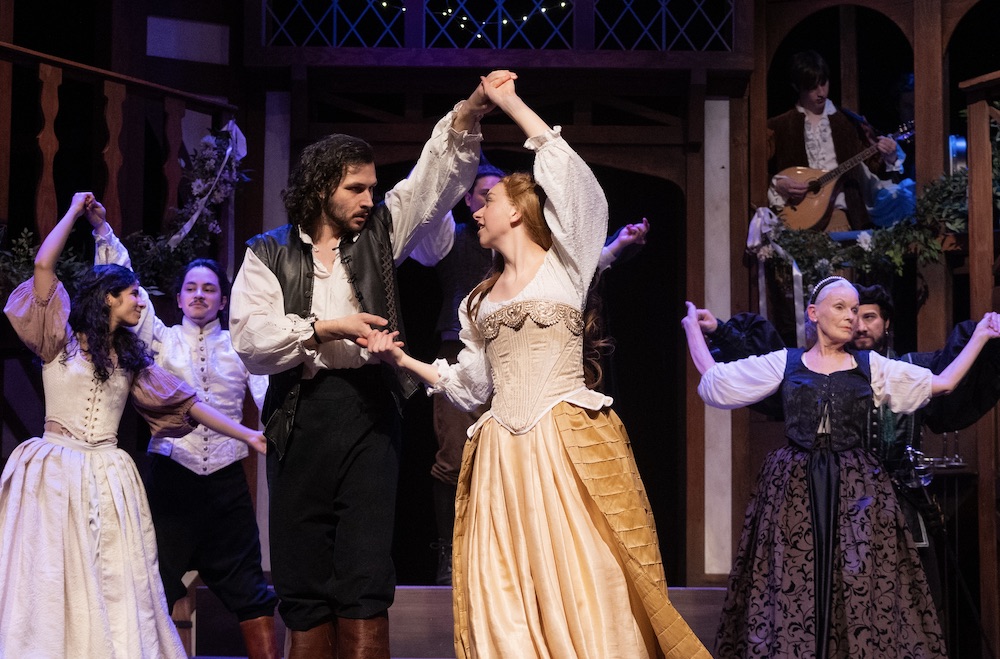
To be fully successful, any production of Shakespeare in Love must capture three layers of love.
The entry level to Lee Hall’s script, which is an adaptation of Marc Norman and Tom Stoppard’s screenplay for the 1998 film, is a fictional love affair between William Shakespeare, whose reputation has yet to solidify, and a wealthy young woman named Viola de Lesseps, who desperately wants to be an actor.
Because it’s illegal for women to appear onstage, Viola disguises herself as a young man, names her new persona Thomas Kent, and lands the role of Romeo in a play that is, at this point, tentatively titled Romeo and Ethel, the Pirate’s Daughter.
So there’s romantic love and the love of theatre itself, the world of players and playwrights.
Crucially, there’s a third layer: the adoration of language, specifically Shakespeare’s poetry. In Shakespeare in Love, Will casts Viola as Romeo because she is uniquely able to deliver his text. “Where did you learn to do that?” Will asks, astonished, when Viola auditions, using one of his monologues. “There is no playhouse in London where my verse is spoke truly.”
Viola feels Will’s language. She gets it. And she loves him for his sensibilities. As if ambushed by this deep and sudden kinship, Will loves Viola/Thomas right back.
Significantly, directed by Sarah Rodgers, this semi-professional production for Metro Theatre gets one of these things, the affectionate evocation of the world of theatre, very right.
I’ll get back to that, but let’s get the hard part out of the way first: Cassie Unger is miscast as Viola. When called upon to deliver Shakespearean text — in Viola’s audition speech from The Two Gentlemen of Verona; voicing Sonnet 18, which begins “Shall I compare thee to a summer’s day?”; in the palmers’ dialogue in which Romeo and Juliet first swoon for each other — Unger sits on the surface of the text, reciting rather than discovering it.
Because Shakespeare in Love is so much about the appreciation of language, Unger’s inability to make that appreciation credible is a significant problem. And her tendency to stay on the surface throws the Viola/Will romance off kilter.
To be fair, the role of Viola is a very large assignment. It’s not catastrophic that Unger isn’t ready for it at this point in her career.
And I do not want to leave the impression that Unger’s lack of readiness wrecks the show. Far from it. Overall, there’s a high level of confidence and an impressive, though not flawless, level of consistency to this production.
With easy access to the nuances of the verse and the emotional stakes of the narrative, Jacob Leonard makes a strong Will. When Will’s friend and rival Christopher Marlowe is stabbed to death and Will blames himself, his sudden grief and guilt are moving. Playing Viola’s Nurse, Liz Connors delivers a fierce, loving, grounded performance. Chris McBeath commands the stage as Queen Elizabeth. And as Wessex, the impoverished nobleman to whom Viola is about to be sold in marriage, Vincent Keats is dashing and, although Wessex is misogyny incarnate, Keats makes the character passionate rather than a cartoon villain. Playing theatre owner Philip Henslowe, longtime pro Simon Webb inhabits the language and the period as if born to them.
Collectively, this roster covers a lot of theatrical real estate in this production. and these performers are just the standouts in an impressively solid cast.
It’s no mean feat that director Rodgers moves her twenty players — twenty — fluidly around Omanie Elias’s handsome Tudor set. And Rodgers has made the excellent choice of complementing the text with period music — a recorder, a lute, and voices, among other instruments — under Toby Verchere’s musical direction.
I do have a couple of outstanding problems with both Hall’s adaptation and Rodgers’ direction. Hall’s decision to have Marlowe influence Shakespeare’s work as significantly as he does undermines the script’s competing assertions of Shakespeare’s genius, and undercuts the Will/Viola relationship as it’s presented in the film, where Will’s relationship with Viola is the central source of inspiration.
Hall leans disappointingly towards a heteronormative framing of Viola’s adventure in gender. “The crossdressing came as a bit of a surprise,” a boatman tells Will — and the line gets a big laugh. “I am a lady,” Viola coos as Will removes her moustache.
Too often for my taste, Rodgers favours the script’s potential for low comedy over its potential for dizzying romance. In rehearsal, Will takes the role of Juliet to teach Thomas/Viola how to deliver a stage kiss: Rodgers turns the moment into a slapstick joke of horniness as opposed to a sincerely passionate — and, for the rest of the company, quietly bewildering — surge of mutual desire.
I have said a lot here and some it if is complicated, but the simple version of the truth is that, on the whole, I had a good time with this production. That’s largely about its evocation of the script’s love for the world of theatre. I was happy to sit in an audience so appreciative of the craziness and daring of playwrights and players. And I was happy in my feeling that, whether we all named it as such or not, we all sensed our crucial role in the fantastical creation of imaginary worlds.
SHAKESPEARE IN LOVE adapted for the stage by Lee Hall, based on the screenplay by Marc Norman and Tom Stoppard. Directed by Sarah Rodgers. A Metro Theatre Production. Running at the Metro Theatre until April 25. Tickets and information.
PHOTO CREDIT: (Photo of Jacob Leonard and Cassie Unger by Moonrider Productions)
THERE’S MORE! You can get all my current reviews PLUS curated local, national, and international arts coverage in your inbox FREE every week if you subscribe to Fresh Sheet, the Newsletter. Just click that link. (Unsubscribe at any time. Super easy. No hard feelings.) Check it out.



0 Comments