
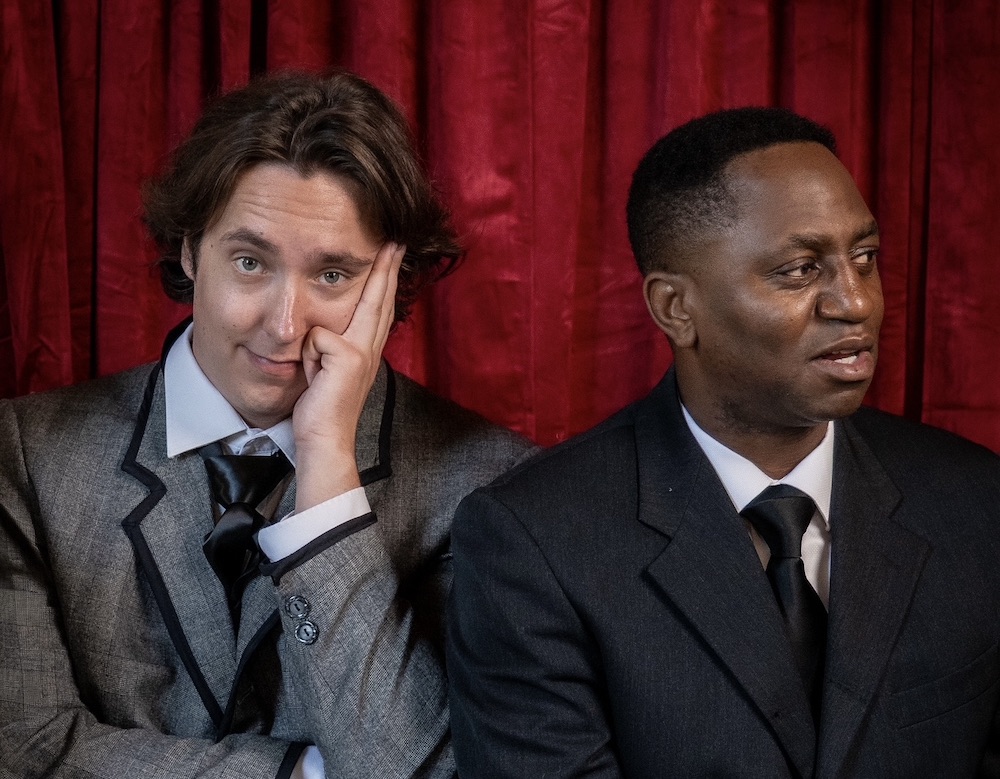
John Lazarus’s new play Running Wilde runs all over the place. It doesn’t know what it wants to be or do, and, directed by Roy Surette, this United Players production often adds to the confusion.
A little background: before Oscar Wilde had written any plays, he was famous as a kind of charismatic spokesmodel for the aesthetic movement, which viewed art and beauty as worthy of celebration in and of themselves. This was in direct opposition to the more common Victorian view that art should be useful, preferably as a tool for moral instruction.
In 1882, the 27-year-old Wilde went on an enormously successful lecture tour of the U.S and Canada. After a stop in Kingston, Wilde missed his train out of town. In Running Wilde, Lazarus imagines what might have caused him to miss that train.
The script.
Borrowing bits of plot from The Importance of Being Earnest and Lady Windermere’s Fan, Running Wilde mostly tries to be a comedy and mostly fails on that front.
There are farcical elements, but there’s none of the accumulation that farce demands. A bellboy named Algernon brings his beloved, Gwendolyn, a reporter for the local newspaper, into Wilde’s hotel suite, and hides her in the bedroom closet when they hear Wilde’s valet Davenport coming. But that situation resolves too easily, and other farcical elements are too sporadic to cohere.
There are also attempts at verbal wit but the play’s many references to Wilde’s later work, including, as you may have noticed, the names Algernon and Gwendolyn (from The Importance of Being Earnest), are such low-hanging fruit that they can’t really be considered witty.
And many of the other jokes are just goofy. Historically, Wilde’s tour was sponsored by the D’Oyly Carte Company, for instance, and, In Running Wilde, Algernon can’t get the name right. Okay.
The script’s core tension is deliberately melodramatic. Oscar supports Algernon and Gwendolyn in their desire to marry, despite their families’ objections and threats of disinheritance. But Gwendolyn’s guardian, her Aunt Augusta, possesses a packet of passionate love letters that Wilde wrote to her male relative Dorian and she blackmails Oscar, threatening to reveal the correspondence if he doesn’t support her marital scheme for Gwendolyn.
But, because we all know Wilde wasn’t imprisoned until years later, there are no real stakes in this plotline.
Then, miraculously, the skies clear. Following Wilde’s lecture, a man who calls himself Earnest shows up at his hotel-room door. Wilde’s assertions that men can be sensitive to beauty, that men can be emotionally responsive and expressive, has made Earnest delirious with possibility. Earnest is a repressed gay man; his situation and the spark of Eros between him and Oscar suddenly give Augusta’s threats a credible human context — and, at long last, the play finds its groove.
But containment within that groove is fitful at best. Act 2 is generally an improvement over Act 1; its explorations of race, class, and misogyny are welcome. But there’s still a lot of comedy that doesn’t work, and the happy-slappy ending is far too convenient.
Let’s talk about the production.
Actor Bob Frazer is a gift when he arrives as Earnest. Frazer is a pro and one of the best. He brings both emotional clarity and clean comic timing.
Conor Kavanaugh, who’s playing Oscar, was over the top at the beginning of the evening on opening night, but he settled into a performance of more persuasive intelligence and charm.
This might be a good time to mention that rehearsals for Running Wilde were so plagued by illness, recasting, and other difficulties that opening night was the cast’s first time in front of an audience. That leap can be incredibly disorienting, which might partially explain why Russell Zishiri (Davenport) sometimes seemed so lost.
Sally Clark’s portrait of Aunt Augusta is a grab bag of twitchy, ungrounded gestures, attitudes, and poses. It really doesn’t work. Playing Algernon, aka Alan, Peter Jaworek fills that space amiably enough, although director Surette could have helped him more with the character’s big displays of emotion — maybe by cutting them. Late-in-the-game replacement Emma Moon’s portrait of Gwendolyn is refreshingly naturalistic.
I appreciated the swooping Victorian lines of Starlynn Chen’s set, although the lip of a raised area upstage is so close to the downstage furniture that it creates significant traffic problems for the actors, and I had to look up why the set is covered with sunflowers: that bloom was an emblem of the aesthetic movement — but is that really going to resonate?
In Lazarus’s script, characters deliver asides, commenting on the conventions of theatrical storytelling. Sometimes, mostly in the later going, these asides work but too often they’re not funny as written, and director Surette’s staging of them is rarely crisp enough.
Naomi Lazarus’s costumes meet with mixed success. She gives Gwendolyn a couple of handsome tailored outfits but most of Augusta’s dresses just look like piles of fabric. And there are a number of obvious mistakes, including Oscar’s too-small velvet jacket.
So it’s a long night: islands of resonance surrounded by incoherence.
RUNNING WILDE by John Lazarus. Directed by Roy Surette. A United Players production in association with Western Gold Theatre. At the Jericho Arts Centre until September 27. Tickets and information.
PHOTO CREDIT: (Photo of Conor Kavanagh and Russell Zishiri by Cameron Clark Anderson)
ACTIVATE YOUR FREE SUBSCRIPTION TO THE FRESH SHEET NEWSLETTER AND GET MY LATEST REVIEWS — PLUS ESSENTIAL GLOBAL ARTS COVERAGE — STRAIGHT TO YOUR INBOX EVERY WEEK. UNSUBSCRIBE ANYTIME.


0 Comments