
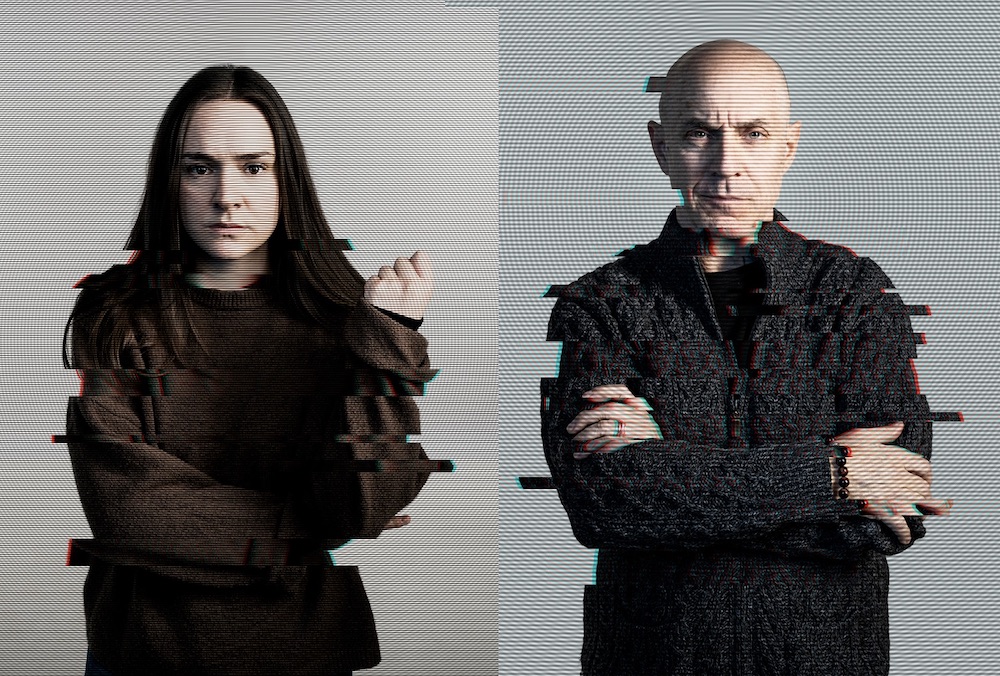
The Search Party’s production is excellent.
My sense of the play’s fundamental flaw has hardened considerably in the hours since I’ve seen it.
But keep in mind, as you read this review, that both the play and production contain riches you might want to experience.
Playwright Max Wolf Friedlich’s JOB opens with Jane pointing a handgun at her therapist, Lloyd. Jane is on extended leave from her job as a content moderator for one of Silicon Valley’s big tech firms. (We’re in the Bay Area.) Jane’s role has been to search out the most violent and perverse online content and then purge it, not just from her company’s servers, but from the internet itself. One day, Jane snapped and video of her standing on a company desk and screaming went viral. Jane can’t return to work until Lloyd gives his okay.
Watching JOB, I was never bored. I always take notes when I’m seeing a show to review it but, this time, I found myself taking notes as if I were Jane’s therapist, trying to shape an understanding that would connect her desperation, work, and stories of emotional alienation. Not that Jane presents herself as a victim. When Lloyd expresses empathy regarding the toll of her job, Jane responds, “It’s a fucking privilege to suffer as much as I do.”
For me, JOB is about the clash between the vastness of the horror to which the internet exposes us, and our inability as individual human organisms to process emotional engagement — and responsibility — on that scale. Jane says, “Because of my job, I am allowed to care.” She also says something like, “You have to take the bad out of the world and store it in your body”, and “Nobody else can do what I do.”
Uh oh.
For me, this resonates.
And the script creates a showcase for bravura performances.
Elizabeth Barrett’s work as Jane is, without a doubt, one of the finest feats of acting we’ll witness this season — or, honestly, any other season. Throughout a huge range of emotions, Barrett is flawlessly credible. Through her, you can see Jane nimbly shifting her strategies. And Barrett knows how to spin the script’s considerable humour. When Lloyd, who is old enough to be Jane’s dad, condescends about her generation’s dependence on tech, Jane frames the divide as “tech bros and hippies at war.” She blames hippie regulations for creating San Francisco’s housing crisis before adding, “Now they’re pissed that somebody has interrupted their 50-year-long drum circle.”
The script doesn’t present the actor playing Lloyd with the same opportunities for emotional gymnastics, but, as Lloyd, Brian Markinson impresses with the fulness of his presence: listening, processing, responding — and doing his own strategizing.
My experience of this show took a turn when, in its final movement, the script fully embraced its identity as a thriller, shifting its focus from psychological portraiture and cultural observation to a kind of whodunnit. For me, this significantly undermined what had come before.
And that’s the position that hardened over the next hours. Violence (especially sexual violence) inflicted upon children is Jane’s central obsession, and JOB exposes its audiences to disturbing imagery. I was okay with receiving this material when I felt it was being taking seriously, but not when I realized the extent to which the energy of its horrors was being used to fuel what is, essentially, a trivial theatrical game.
One of the huge problems with the flood of information in our technological culture is that it creates false equivalencies. Everything from Stevie Nicks’s latest hippie dress to a child perishing in Gaza comes at us with the same speed and intensity. In that sense, it all has the same value.
JOB creates its own false equivalency in the form of an ethically untenable juxtaposition. I applaud its acknowledgement of the unbearableness of our technological culture. But I object to its paradoxical exploitation of real suffering. Yes, kids are being abused to create online content. But gamifying that reality, as happens here, is a bad idea.
Still, as I said, there are riches. The performances. And, as is always the case with Search Party productions, which are always directed by Mindy Parfitt, the design elements are immaculate. Gerald King’s expressionistic lighting juxtaposes industrial harshness with the warmth of natural sources. Kate De Lorme’s cinematic sound design backs that up. And Amir Ofek’s set is instantly recognizable as a therapist’s office, although its lines are far too clean to align with Jane’s observation that it’s “very Haight-Ashbury”.
The Cultch has long been a champion of The Search Party’s work. I’m grateful for their combined commitment to consistently presenting us with plays that are worth thinking about.
JOB by Max Wolf Friedlich. Directed by Mindy Parfitt. A Search Party production presented by The Cultch at The Cultch’s Historic Theatre until October 11. Tickets and information.
PHOTO CREDIT: (This publicity image of Elizabeth Barrett and Brian Markinson was created by Emily Cooper.)
ACTIVATE YOUR FREE SUBSCRIPTION TO THE FRESH SHEET NEWSLETTER AND GET MY LATEST REVIEWS — PLUS ESSENTIAL GLOBAL ARTS COVERAGE — STRAIGHT TO YOUR INBOX EVERY WEEK. UNSUBSCRIBE ANYTIME.


0 Comments