
Henrik Ibsen’s Rosmersholm is dense as… Oh man, I don’t want to use an expletive in my first sentence, so let’s just say it’s very dense — and so rewarding.
Director Alexander Steele Zonjic’s staging and adaption of the script are innovative and audacious.
This is all very good news, especially since this is the debut production of a new Vancouver company that’s calling itself Company Research.
Zionjic’s telling stays true to the bones of Ibsen’s original. Johannes (John) Rosmer is from a family so proud and wealthy that their house, Rosmersholm, has become a symbol to the locals of the values of their society. More broadly, in the script, Rosmersholm becomes a symbol of the values of Norwegian culture in the late nineteenth century, which, like the moral underpinnings of our current culture, were being thoroughly contested.
John’s wife Beata has committed suicide — gruesomely, by throwing herself into the river above the nearby mill. Rebecca West, who was hired as Beata’s companion, has continued to live with John in Rosmersholm, with a shared commitment to chaste friendship. Rebecca has also been introducing John to progressive ideas, including respect for working people and the renunciation of religion.
John has been a respected Christian pastor so, when he tells Beata’s conservative brother Kroll, who has been a close friend, that he has foresworn religion and embraced the idea of personal freedom, Kroll feels betrayed and he turns his fury into accusations of moral laxness, including suspicion about a possible sexual relationship between John and Rebecca, and he threatens to expose them both.
This opens up a layered consideration of idealism as it’s framed in absolutist notions of innocence that overlap to a significant degree with the imperative of sexual continence — so you know the undertow is going to include a lot of guilt and shame.
The story unfolds in a series of revelations. I won’t give those revelations away, but I will say that their accumulating depth makes for compelling viewing.
As director and adapter, Zonjic adds heightened theatricality.
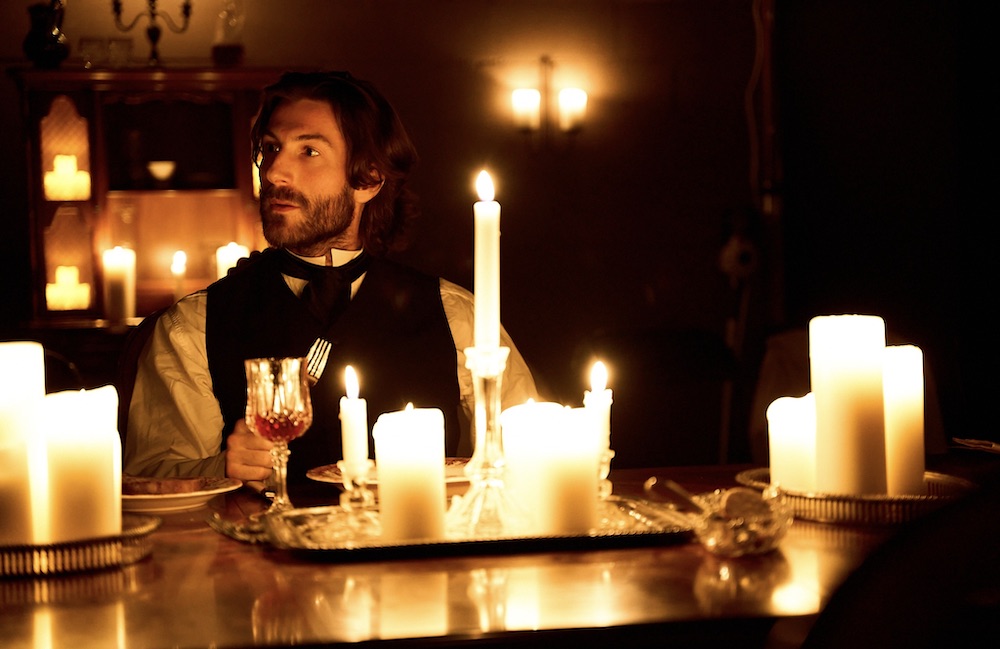
Once you’ve tracked down the venue — the address is only revealed when you buy your tickets — you line up and enter the darkened playing area two to four people at a time. The space is lit only by four candles, so just getting seated feels like a ritual.
Still, I’m of two minds about that darkness: because of its hard walls, the room echoes so, when the play began, I had difficulty at first hearing what people were saying, especially since I could barely see their faces, even when many more candles were lit. I adjusted to the darkness and the sound, but I still wanted to see the actors more clearly.
Zonjic has cut the four-act play, which usually takes about two hours and 40 minutes to perform, down to 100 minutes played straight through, so it moves like stink — although I’ve got to say that I’ve just read R. Farquharson Sharp’s full, four-act translation; it’s a pleasure to read and never feels like it’s dawdling.
Zonjic has added a new framing device: John and Rebecca are about to host a memorial service for Beata on the first anniversary of her death, so there’s an added time crunch and the stakes are heightened further as other characters plot to exploit the occasion. Artistically, this is a huge deal, and it works.
Zonjic has also added bold moments of staging. As they arrange and rearrange the candles and other props to set the scenes, Miss Helseth, who is a servant, is joined by three other “maids”, who sing a Norwegian folk song in gorgeous a cappella harmony. I found their song haunting even before Zonjic told me that it’s about a young bride’s premonition of suicide: “I weep for the bridge/Where to the bottom sank my sisters.”
I feel less resolved about, but still intrigued by, other staging choices.
Off the top, in Ibsen’s original, Rebecca peers through the curtains to see who’s coming to the house. In Zonjic’s reimagination, she climbs to the middle of the large formal dining table that is the main set piece to get a better view and insists that Miss Helseth join her. Nothing like this would ever have happened in real life, of course. I could understand the moment interpretatively as an expression of Rebecca’s disruptiveness, but, since the majority of interactions in Zonjic’s staging are realistic, it also left me confused about the terms of the world he has created.
If felt much the same way about Rebecca’s corset. In the interpretation of the original that I read, Rebecca appears at one point in her “morning wrap”, which scandalizes Kroll when he comes to visit. Here, Rebecca shows up in a slip and corset. I understand that Zonjic is emphasizing the sexual aspect of Rebecca’s disruptiveness, but I found this visual statement heavy-handed and distracting.
(A side note: there’s a scene, a bit later in the game, in which Kroll questions Rebecca’s parentage and frames his evidence as proof of Rebecca’s inherently immoral nature. Gotta love biological determinism. In the original, this confrontation is about the possibility that Rebeccas was born out of wedlock. For our time period, Zonjic has upped the stakes considerably. I’ll leave the precise terms of this for you to discover, but I will say they work.)
To tie up my discussion of style: I had no problem with the presence of Beata’s ghost (which is not part of the original) — until other characters started talking to it. Apparently, there’s a clear delineation in my head between ghostly and human realities, but that delineation was violated in these brief and, I think, unnecessary exchanges.
Please understand: I’m going into detail with all this because this adaptation and production are so interesting and challenging. I don’t mean to dismiss them in any way.
As an adapter and writer, two of Zonjic’s most significant successes are the reinventions of characters named Brendel and Mortensgaard.
Ibsen presents Brendel as a kind of sad clown, John’s deluded former tutor who has fallen on hard times. Zonjic makes him into John’s once-promising classmate. In both iterations, Brendel embodies the hollowness of idealism: he tries to make a revolutionary speech only to discover he has nothing to say. The great strength of Zonjic’s revision — and of Nathan Kay’s masterful performance in the role — is that Zonjic has a sense of humour about his ridiculousness. This choice adds extraordinarily valuable variety to the music of this piece.
Mortensgaard is a newspaper publisher whom John very nearly ruined by revealing a sexual “impropriety” years earlier. Now, Mortensgaard is in a position that would allow him to ruin John.
Zonjic has expanded Mortensgaard’s backstory, which adds welcome weight to the character’s pragmatism: his basic take is that complete honesty can be damaging and that it’s important to practice realpolitik. To my mind, this makes Mortensgaard the most appealingly sophisticated character in Rosmersholm, and Elijah Silva’s performance in the role is gorgeous. Understated, thoughtful, and clear-eyed, it adds its own subdued, satisfying music.
Blessedly, under Zonjic’s direction, every performance in this production is thoroughly honest and intelligent: Spencer Lord’s wounded, enraged, MAGA-like Kroll; Cesare Scarpone’s innocent, searching John; Siona Gareau-Brennan’s idealistic and desperately calculating Rebecca; and Reece Braaten’s quietly resistant Miss Helseth.
The passion of the collective enterprise results in volume that feels emotionally authentic, but gets wearying when it starts to feel relentless. More modulation would help.
Blah, blah, blah. I’ve gone on. But, as I said, that’s a function of my enthusiasm. I encourage you to see Company Research’s Rosmersholm. It offers a rare opportunity to engage in a complex and ambitious theatrical adventure.
ROSMERSHOLM by Henrik Ibsen. Adapted and directed by Alexander Steele Zonjic. A Company Research production playing until November 29. Tickets and information. (When you buy your tickets, they tell you the venue.)
PHOTO CREDIT: (This photo of Cesare Scarpone as Johannes Rosmer is by Pascal Lamothe-Kipnes.)
ACTIVATE YOUR FREE SUBSCRIPTION TO THE FRESH SHEET NEWSLETTER AND GET MY LATEST REVIEWS — PLUS ESSENTIAL GLOBAL ARTS COVERAGE — STRAIGHT TO YOUR INBOX EVERY WEEK. UNSUBSCRIBE ANYTIME.




0 Comments