

It’s exhilarating to see somebody colouring outside the lines for a change. Aaron Bushkowsky’s new play, The Replacement Wife, is a reality-bending comedy about marriage, death, and the fickle nature of love. Its pieces didn’t come together for me in a substantial way until Act 2, but, for the most part, I was grateful when they did.
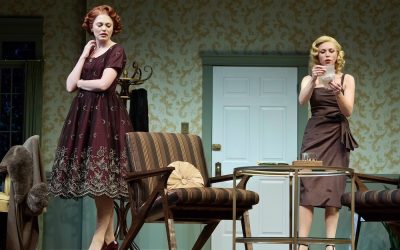
Ben and Jackie have been married 37 years. He’s a bumbling professor. She has run out of treatment options for her cancer. (I did say this script is a comedy. Wait for it.) When Jackie’s best friend Rachel offers to pony up $200,000 for an experimental treatment in Mexico, Jackie says she’ll accept the offer — if Rachel will stay with Ben while she’s away, so he won’t be alone if she dies. Rachel and Ben can’t stand each other. Rachel accepts the deal.
There are two intriguing secondary characters. Ben’s friend Glenn is a greeter somewhere. Maybe Walmart. These guys refer to themselves as a couple of old philosophers but, when Ben, who’s facing retirement, a stale marriage, and his wife’s mortality, asks, “What happens next? What are we supposed to do?”, Glenn pulls blanks. Later, he says, “Never quote Nietzsche to a woman”, which is, of course, less helpful than nothing.
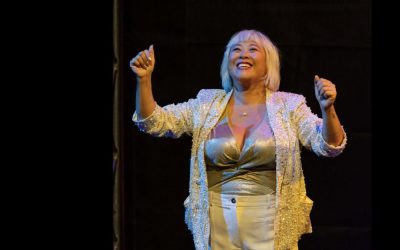
In Mexico, Jackie meets a generation-younger female patient named Suzi. Stoned on the treatment cocktail, which heightens her already clown-like forthrightness, Suzi gets some of the best lines in the script. “People who are 80 and hate life are really starting to bug me,” she says. “Just shut up! And finish your soup.” Both stoned — the cocktail includes oxycontin — Jackie and Suzi dance little ballets with each other and their IV poles and improvise gibberish philosophies.
About Act 1: because the set-up rambles, it takes too long for narrative stakes to be established. And the banter — between Ben and Jackie, and especially between Ben and Rachel — which is supposed to be funny, isn’t; Ben isn’t nearly the wit he thinks he is. This, combined with the fact that the script sets Rachel up as a caricature, makes it much more rewarding, in the first act, to watch the genuine and appealingly absurd affection as it grows between Jackie and Suzi.
Then, in Act 2, the mysterious nature of Glenn’s job starts to come into focus and, for me, that triggered a kind of tectonic shift. Although the nature of Glenn’s occupation never completely resolves, which is great, it clarifies enough to open questions about overlapping realities, which is conceptually expansive. And, as relationships shift and deepen, the plot acquires significant stakes that force questions about integrity: loyalty and honesty. How do we balance our obligations to ourselves with our obligations to those to whom we’ve made commitments? To rejig Ben’s earlier questions, What should any of us do with the time we have left?
I haven’t seen actor Miriam Smith onstage in approximately one hundred years, but I’m very pleased to see her again here. In Smith’s performance, Jackie’s internal life — her fear, courage, pain, generosity — is deep and vivid. Smith isn’t overacting; her eyes are simply so alive you know she’s feeling all of it.
As written, Suzi is the script’s most original character and, playing her, young performer Ella Wood hits a winning combination of zaniness and deadpan delivery, adding grace notes of tenderness and fury.
Even in the weaker first act, Kathryn Stuart, who’s playing Rachel, occasionally peels back the stylistic layers to touch the ground. When Jackie first reveals her diagnosis, Rachel replies, “I’d change places with you.” Stuart’s delivery is so simple you know Rachel means it. And, as the script gives Rachel more room to grow and expand in Act 2, Stuart takes full advantage of the opportunities.
I don’t know if there’s a lot more that actor Bill Dow could be doing with Ben. As my female companion pointed out, there’s a significant problem with the writing that follows this character into Act 2: in the relationship machinations, Ben is presented as something of a romantic prize but, oblivious to his own shortcomings and domestically useless, Ben is emphatically not that.
If Bushkowsky wants to consider a rewrite of The Replacement Wife, there’s room for improvement.
That said, my overall sense of satisfaction with the existing script shifted dramatically. At the end of the first act, I felt like The Replacement Wife had offered me playfulness layered on top of not much. By the end of Act 2, I felt energized by the script’s conceptual audacity and thematic challenges.
Speaking of the script’s strengths, off the top, I promised proof of The Replacement Wife‘s comic bona fides. I haven’t delivered enough on that. So here’s Rachel’s pronouncement: “Old people who are holding hands look like they’re just doing it for balance.” Stikes home for me — although, as the script knows well, it’s not the whole picture.
THE REPLACEMENT WIFE by Aaron Bushkowsky. Directed by Johnna Wright. A United Players production in association with Solo Collective. At the Jericho Arts Centre until February 15. Tickets and information.
PHOTO CREDIT: Miriam Smith (L, as Jackie) and Ella Wood (Suzi) dancing with cancer. (Photo by Michelle Lee. Costumes by Starlynn Chen.)
THERE’S MORE! You can get all my current reviews PLUS curated local, national, and international arts coverage in your inbox FREE every week if you subscribe to Fresh Sheet, the Newsletter. Just click that link. (Unsubscribe at any time. Super easy. No hard feelings.) Check it out.


0 Comments