
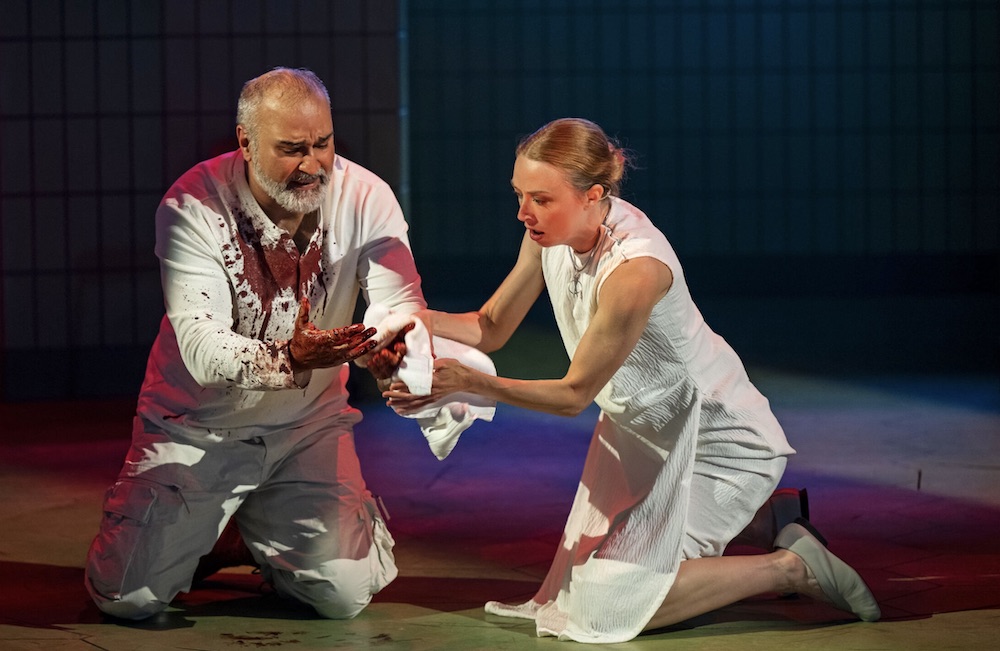
Corruption, ambition, willingness to cause and collude in suffering and death: Macbeth resonates. What sins are Trump, Musk, Bezos, Zuckerberg et al willing to commit to feed their appetites for money and power? What are the rest of us supposed to do with our helplessness and grief?
Director Stephen Drover’s production for Bard on the Beach is almost never overtly political, but it is set in the near future and the political undertone is undeniable. Watching the end of the play, when Macbeth had been killed and Malcolm, Scotland’s new king, promised to “bring to justice the cruel ministers/ Of this dead butcher and his fiend-like queen”, I couldn’t help but think, “I cannot wait!”
It helps, of course, that this interpretation is excellent. It’s not perfect — I have quibbles here and there — but I don’t really care about any of that because Drover’s Macbeth is clear, passionate, inventive, and horrifying.
If you don’t know the play, supernatural visits from three witches unleash Scottish nobleman Macbeth’s royal ambitions. With his wife, Lady Macbeth, he plots and executes the murder of King Duncan and becomes king himself. But, as Macbeth says, “Blood will have blood”, and he is soon arranging the murders of others, including his friend Banquo and the wife and children of the rebellious lord, Macduff, to shore up his position and appease his sense of grievance.
Because they’re at the heart of this production, I’m going to start with a couple of performances that I think could use tightening.
The emotional force of Tess Degenstein’s Lady M is undeniable. But she breaks up the flow of the iambic pentameter — most of Macbeth is written in verse — with halting rhythms that feel arbitrary: “What cannot [break] you and I perform upon the unguarded Duncan?” In my observation, the delivery of verse works best when you sustain the thought to the end of the sentence. Even in real life, speech is seldom this choppy.
But, as I said, Degenstein’s passion wins out. As Lady Macbeth is priming herself to murder Duncan, she delivers an invocation that begins, “Come you spirits/ That tend on mortal thoughts, unsex me here,/ And fill me to the crown to the toe top-full/ Of direst cruelty.” In Degenstein’s embodiment, this speech becomes a full-on, dark Satanic ritual that carries more force than any other approach to it I’ve seen.
Lady M’s “Out, damned spot” soliloquy is often delivered as a demure meditation on obsession, but Degenstein’s Lady Macbeth is terrorized. For the first time ever, I felt like I was seeing the real craziness in the character as she careened towards her suicide.
On opening night, I felt Munish Sharma started off weakly as Macbeth. In the text, Macbeth is considering slaughtering Duncan pretty much from the get-go, but I couldn’t locate a whiff of murderous ambition in Sharma’s take. Yes, Macbeth is conflicted in the early going but, even when that conflict should be sharpest, in the thane’s “If it were done when ‘tis done, then ‘twere well/ It were done quickly” soliloquy, I didn’t see any investment in the tumultuous internal argument, an investment that would have helped illuminate the character’s instability.
But, after the murder, when Sharma’s Macbeth moved into horror (“Wake Duncan with thy knocking. I would thou couldst”) and rage, especially rage, the characterization lit up and gained considerable size.
There’s a clear flip in this production as Macbeth hardens in his conviction and his wife unravels. And there’s a clear arc in the title character’s progression. Holding up a steady hand, even as he’s threatened by a massive army, Sharma’s Macbeth declares, in wonder, “I have almost forgot the taste of fear.”
There are so many strong — again clear — supporting characterizations: the undeniable morality of Sebastian Kroon’s Banquo, for instance, and the tenderness this Banquo feels for his son Fleance, upon whom Macbeth will set his murderous sights. Steffanie Davis brings touching vulnerability to Lady Macduff, whose husband has fled the country, leaving her — and all their children — mortally at risk, and Davis owns the comedic confidence necessary to perform the role of the drunken Porter. Playing a lord named Ross and even in a bit part as a Citizen, the clarity of Melissa Oei’s diction and her unadorned investment in the meaning of the text, are boons.
I also want to talk about the scene in which Duncan’s son Malcolm, the rightful heir to the Scottish throne, tests Macduff’s loyalty only to be interrupted by Ross, who’s bringing news of the slaughter of Macduff’s family. This is one of the richest passages in the script and it’s exquisitely well played here by Oei as Ross, Sara Vickruck (Malcolm), and Jacob Leonard (Macduff). Reacting to the horror of Ross’s revelation, Leonard’s Macduff oscillates between trying to keep it together and completely falling apart: “All my pretty ones?/ Did you say all?”
With its windswept sounds of desolation and heart-quickening pulses, Mary Jane Coomber’s sound design saturates this production. In a wonderfully alienating convention, the witches speak in recorded — and distorted — voices as the actors mouth their lines onstage. When those witches are about to invade Macbeth’s castle, the lights flicker on Amir Ofek’s surgically antiseptic set and Jeff Harrison’s lighting animates the steam rising from the grates in the floor.
In the Porter’s scene, director Drover has taken the Porter’s line, “Knock, knock, knock! Who’s there, i’ th’ name of Beelzebub?” and framed the Porter’s monologue in the format of knock-knock jokes. In Shakespeare’s original, the Porter summons into hell, among others, a tailor who has stolen scraps of expensive cloth; in Drover’s take, she invites, among others, the rich patron who politicizes climate change.
And Drover treats the play as the horror show it is, adding flourishes, which I won’t give away, to the end of each of the two acts it gets here, keeping the tension on a furious boil.
All of this is why I was on my feet for the curtain call. Passion. Clarity. Horror. Yes.
MACBETH by William Shakespeare. Adapted and directed by Stephen Drover. A Bard on the Beach production running in rep in the Mainstage tent until September 18. Tickets and information.
For the blind and those with limited vision, VocalEye will provide audio description Macbeth on Sunday, July 26 at 2:00 p.m.
PHOTO CREDIT: (Photo of Munish Sharma and Tess Degenstein by Emily Cooper. Excellent costumes by Alaia Hamer.)
ACTIVATE YOUR FREE SUBSCRIPTION TO THE FRESH SHEET NEWSLETTER AND GET MY LATEST REVIEWS — PLUS ESSENTIAL GLOBAL ARTS COVERAGE — STRAIGHT TO YOUR INBOX EVERY WEEK. UNSUBSCRIBE ANYTIME.

I think the character’s name is Ross, not Scott.
You are absolutely right. Thank you! I’ll make that correction right now.