
Man, I was fighting to stay awake.
On paper, Lloyd Suh’s script sounds like it might be interesting. In Franklinland, Suh has created a fantasia based on the relationship between Benjamin Franklin — the script calls him Ben — and his son William, who was born out of wedlock and went on to become governor of New Jersey.
The script sticks to some of the historical facts, referring to Benjamin’s interest in electricity, for instance, his invention of bifocals and the flexible catheter, and his role as a founding father of the United States. But there’s also a ton of fictionalization, including Ben’s prolonged and enthusiastic endorsement of masturbation. (The historical figure is on record as being against it.) And there’s a lot of exaggeration, especially of Benjamin’s self-regard. There is, arguably, historical evidence for Benjamin’s self-satisfaction but, in Franklinland, it takes on cartoonish proportions as Ben brutally and repeatedly insults William’s intelligence and compares it to his own brilliance.
What’s all this in service of? You could argue, I suppose, that, by exposing its cruelty, Suh is deconstructing the valorization of the individual, the myth of the self-made man, which permeates American culture. More essentially, though, it seems Suh is interested in exploring striving, independence, and compassion (or the lack of it) within the father/son dynamic. In Franklinland, Ben treats William as an extension of himself — inferior but necessary because, to achieve his ambitious goals, Ben needs an assistant. For his part, William is desperate for his father’s approval and equally desperate to achieve his independence.
So, theoretically, Franklinland has potential.
But, in performance, I was engaged by almost none of this.
Mostly, my problems are with the one-act script, which, in six scenes, explores the years between 1752 and 1785.
The play seems intent on being funny, but I almost never found it so; most of the jokes are blunt insults. Early on, when young William tells his dad he wants to be just like him, Ben replies, “Well, I’m kind of a hard act to follow. You might want to set your sights a little lower.” It doesn’t take long for this dynamic to get tedious. For me, as a Canadian, there’s an element of cultural disjuncture: William’s announcement that he has become New Jersey’s governor is followed by a running gag in which Ben repeats “New Jersey!” with disdain. Then there’s the bit in which Ben coughs and coughs, and — somehow — this is supposed to be amusing.
But my biggest problem with the script is that, to me, it feels hermetically sealed in a not very interesting form of abstraction. There’s a lot of talk, but not a lot of tangibility, if you know what I mean. Franklinland gives Ben and William precious little backstory and there are almost no other characters of note. The locations change for every scene but, because the physicality of those locations rarely matters, it almost feels like the scenes, the arguments, could be playing out anywhere.
Clearly, Suh’s focus is on the power dynamics and those do get a bit more interesting as the show progresses. Before the American Revolution, William accepts the governorship of New Jersey, casting his lot with the King of England. But, Ben is a revolutionary figure, so the tables turn and turn again.
In the final scene, we meet William’s own illegitimate son, whom the script identifies as Temple — and the script finally, fleetingly, hints at tenderness.
Mostly, though, the script left me cold.
How well does director Omari Newton’s production negotiate this challenging script?
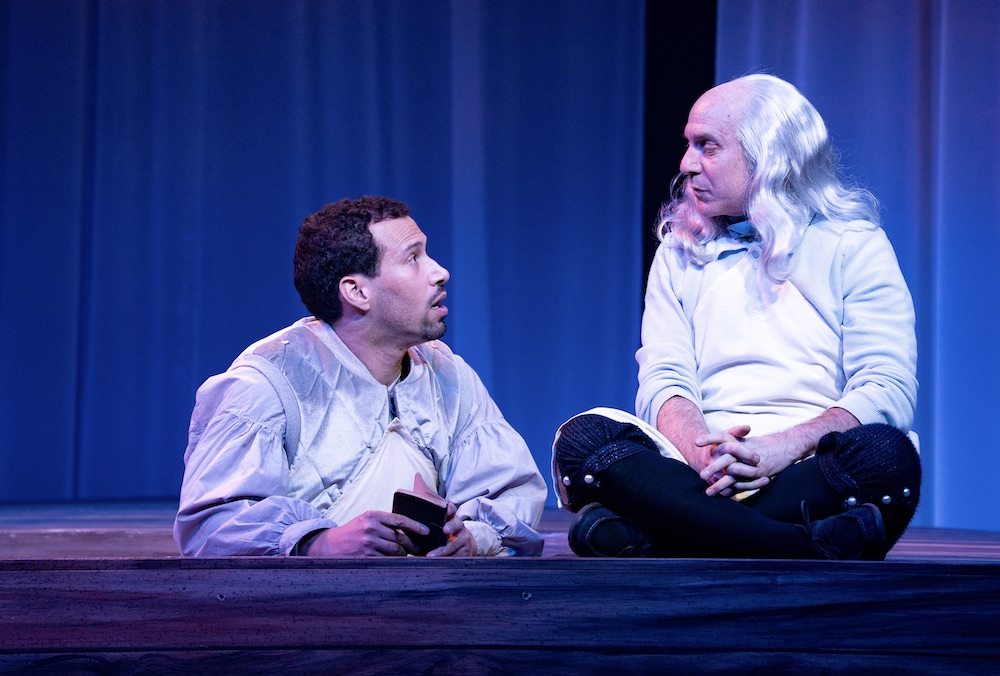
Well, Newton has embraced the script’s artificiality — or stylization, if you’d prefer. Serving Newton’s vision, I assume, set designer Kimira Reddy has created an angled set of broad wooden steps, a choice that nods to the period, without creating literal locations or evoking concrete references. CS Fergusson-Vaux’s costumes are similarly non-period-specific: William, for instance, wears breaches — and sneakers. This is all a good match with the script, which addresses times past through characters who speak in contemporary English, so these choices make sense to me. At the same time, I wonder if it might have been more helpful to counter the terms of the script by giving us more textures, maybe even objects, to hold onto. I was longing for something.
Under Newton’s direction, Brian Markinson is reliably alert as Ben, never more effectively than when Markinson’s Ben reacts — silently — as William unleashes his fury on him.
A choice has been made in Luc Roderique’s performance as Willilam that I don’t understand: under Newton’s direction, Roderique is playing William as if he really is as stupid as Ben claims he is. But this choice doesn’t line up with William’s large vocabulary or his assertion — which goes unchallenged by Ben — that he did well in school. I couldn’t help but wonder what the play would look like in a production that afforded Ben a more forceful adversary.
To be clear, I’m not knocking Roderique’s performance within this choice; I just want to raise the question about the choice itself.
In that final scene, in which Roderique’s vulnerable William meets Temple (played open-heartedly by Jackobe Jenkins), this production gets as close as it ever does to being moving.
Still, watching this mounting of Franklinland was, for the most part, a flat and frustrating experience for me.
FRANKLINLAND by Lloyd Suh. Directed by Omari Newton. An Arts Club Theatre Company production. Running on the Lindsay Family Stage at Granville Island until April 5. Tickets and information.
PHOTO CREDIT: (Photo of Luc Roderique and Brian Markinson by Moonrider Productions. Costumes by CS Fergusson-Vaux.)
THERE’S MORE! You can get all my current reviews PLUS curated local, national, and international arts coverage in your inbox FREE every week if you subscribe to Fresh Sheet, the Newsletter. Just click that link. (Unsubscribe at any time. Super easy. No hard feelings.) Check it out.



0 Comments