
There are moments in this production that, on their own, would be worth the price of admission. And there’s a downright bracing vigor in this stripped-down version of Shakespeare’s Hamlet. There’s also something missing: the central character. Words, not movement, are Hamlet’s native element. And there is no spoken text in Hamlet, Prince of Denmark, which is a collaboration between choreographer Guillaume Côté and director Robert Lepage.
If you’re not familiar with Shakespeare’s play, here’s a quick synopsis: Hamlet’s father, the King of Denmark, has been murdered by Hamlet’s uncle, Claudius, who has assumed the throne and married Hamlet’s mother, Gertrude. When Hamlet’s father’s ghost urges him to exact vengeance, Hamlet is, famously, unable to act: the ur-existentialist, he’s a philosopher immobilized by his questions. Still, Claudius and Gertrude sense something’s afoot, so they set up Hamlet’s university friends, Rosencrantz and Guildenstern, to spy on him, and, through her father, Polonius, force his girlfriend, Ophelia, to betray him.
Telling this story through the body brings some of its elements into bold relief. In theatrical stagings, there’s almost always a whiff of incest in the bedroom scene between Hamlet and Gertrude, for instance. Here there’s a lot more than a whiff. And it works.
Without his simplistic moralizing, Polonius loses his comedic value, but his role in Ophelia’s oppression becomes brutally clear: Polonius wields his staff, the symbol of his authority, like a weapon.
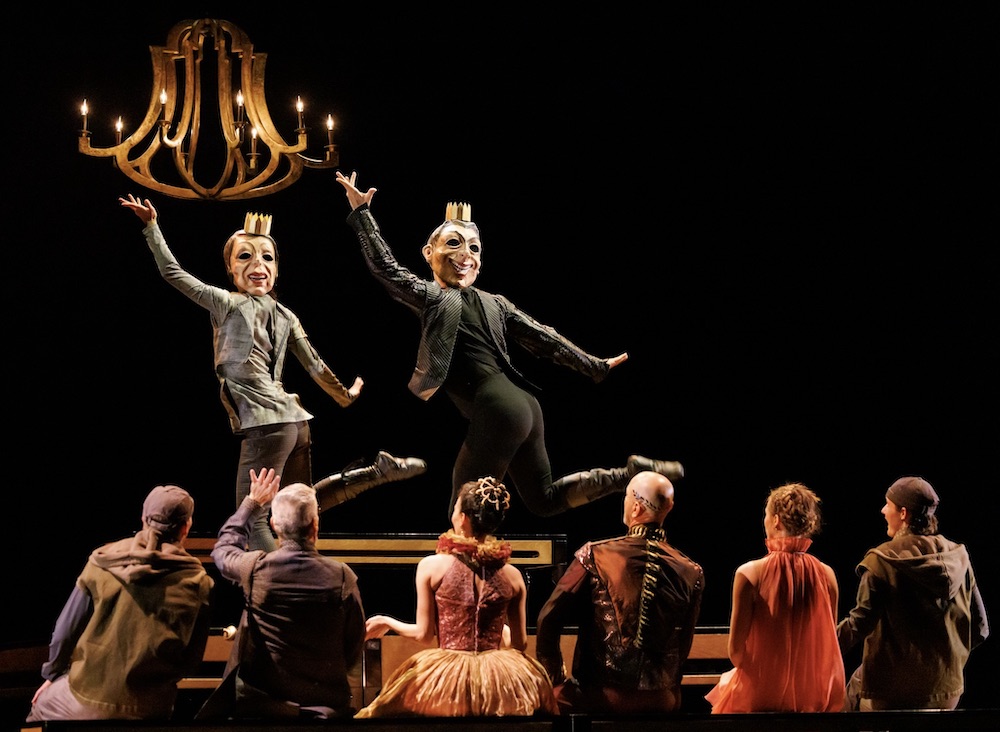
And there are passages of staging that are pure genius. Rather than having a roaming group of players enact King Hamlet’s murder to “catch the conscience of a king”, Hamlet and his best friend, Horatio, perform the dumbshow themselves — wearing masks, backwards, on their heads. The inventiveness is riveting.
Almost everything related to Ophelia fires in this retelling, largely because there are such clear power dynamics and dramatic action in her part of the story. When Ophelia is falling apart after betraying her love, she is surrounded in a hall of mirrors by almost everyone from the court: she can no longer find herself. And her suicide by drowning is a theatrical pièce de resistance. A comforting, silken, blue cloth appears as a new backdrop and she is lured by it, lifted into its currents by unseen hands, swirled, and swallowed. It’s one of those artistic moments you live for. (Don’t worry, I’m not ruining this passage for you; to truly appreciate it, you need to physically experience it.)
In contrast, as written by Shakespeare, Hamlet’s challenges are internal and philosophical. He struggles through them, in his soliloquies, with language. Can he murder Claudius? Is suicide an option for him? Hamlet’s overt strategies are also language-based: in his wordplay in the court, is he feigning madness of going mad?
Hamlet, Prince of Denmark finds effective physical language for virtually none of this. Yes, Hamlet dances duets with Ophelia, Gertrude, and Horatio, but they don’t give us meaningful, empathy-inspiring access to his fundamental struggle, which lives in his mind more than his body.
Under Lepage’s direction, this production is, of course, gorgeous. With its heroic gestures, menace, and volume, its sometimes-driving percussion and machine-like sounds, composer John Gzowski’s original score is a tight match with Côté’s choreography, which combines the romanticism of ballet with more modern, inventive, entwining lifts and elements of street dance. The deep reds and bold volumes of the set, which was co-designed by Lepage and Côte, are dramatically lit by Simon Rossiter. And the Tudor-ish costumes by Michael Gianfrancesco and Monika Onoszko sometimes yield startling moments: in the contrast between Ophelia’s coral undergarments and the aquamarine water that engulfs her, for instance.
I’m a theatre critic so that’s how I’ve approached this review, but I also want to say that, to my eye, the dancers looks strong — athletic, sometimes even gymnastic, precise, and fluid.
In my experience, there’s a significant hole in the centre of Hamlet, Prince of Denmark, but I’m enormously grateful for many of the elements that surround it.
HAMLET, PRINCE OF DENMARK Designed and directed by Robert Lepage. Co-designed and choreographed by Guillaume Côté. Produced by Ex Machina and Côté Danse. Presented by DanceHouse alongside community partners Bard on the Beach and Théâtre la Seizième. Running at the Vancouver Playhouse until March 21. Tickets and information.
PHOTO CREDIT: Horatio (Natasha Poon Woo) and Hamlet (Guillaume Côté) perform the dumb show. (Photo by Bruce Zinger. Costumes by Michael Gianfrancesco and Monika Onoszko. Lighting by Simon Rossiter.)



I’m posting this comment for reader Ross Paul, who was, for some reason, blocked by this site. If anybody else is having similar problems, please let me know.
Thanks,
Colin
Shakespeare without dialogue seems an oxymoron but I was enthralled by this performance. The staging was phenomenal and I particularly admired the performances of the two women principals, especially Ophelia. Her drowning scene was an imaginative and lastingly indelible theatre moment. It is the second time in two years that I have been blown away by a classic piece of theatre performed without dialogue, the other being Morris Panych’s brilliantFrankenstein Revisited at the Stratford Festival. My only disappointment in Robert Lepage’s Hamlet was that the principals were not identified individually by role in the program.
– Ross Paul