
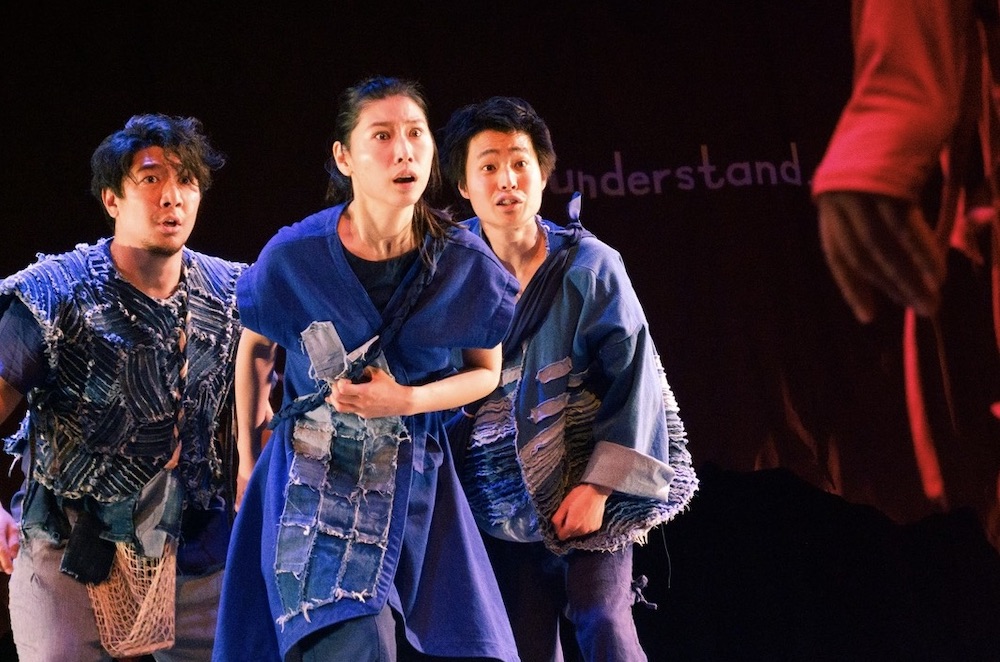
How often do you get to walk into a folktale? Japanese playwright Hideki Noda’s Red Demon, which premiered in Japan in 1996, feels both timeless and timely.
A red creature has washed up on a beach below a Japanese village and most of the villagers, immediately suspicious, label the creature a demon and plot to kill it. Wild rumours spread. A woman named Uta, an outcast herself, is the first to recognize the creature’s humanity. No one in the village uses Uta’s name, referring to her only as That Woman; Uta is beautiful and the men in the village, notably the settlement’s biggest liar, Mizukane, want to have sex with her. Uta refuses, but is blamed for arousing desire.
So Red Demon is about groupthink, fear of difference, misplaced anger, and the ugly ways that fear can be rationalized and weaponized. It’s also about the compassion — and labour — required in challenging dehumanization. You don’t have to look far for current cultural resonance: the demonization of trans folks, including trans kids for God’s sake, the murderous racism of ICE, the cruelty and cowardice of the masked “Got Bones” bullies in Kamloops…
If I’m making it sound like Red Demon is depressing, preachy, or simplistic, I apologize: it is emphatically none of the above. That’s because Noda has imagined his story and the world in which it takes place so thoroughly in folktale terms. His high-stakes plot includes a kidnapped baby, enraged villagers with torches, a magical discovery that I will not give away, and dreams of escape to a far-off kingdom.
There’s a fundamental humanity in all his characters, notably Tombi, Uta’s intellectually impaired and amiably charming older brother. Even Mizukane’s good intensions, when he has them, are gently apparent.
Pedro Chamale, who’s playing the Red Demon, is the only performer who isn’t multiply cast. The other three actors flip through multiple characters, and their transformations add considerable theatricality to the storytelling. In a particularly striking motif, Sarah Tsukishima, who’s playing Ute, stamps her foot and instantly reshapes herself into a harshly commanding village elder.
The story exists in a kind of timeless space, which adds to the sense of folktale. It feels like the plot might be unfolding in feudal Japan, but the text, which has been adapted for this production by director Mayumi Yoshida, also pops in a reference to English Bay, and there’s a sprinkling of nods to pop culture.
For a unilingual English speaker like me, there’s a further, welcome level of abstraction in hearing the text delivered almost entirely in Japanese. There are surtitles but they are, I assume, simplified. And that essentializing process, that purification of the text, if you will, heightens the potency of the storytelling — at least it did for me. (I knew my understanding was imperfect, and I enjoyed the challenge of constructing meaning around the basic architecture.)
All the performances are exemplary: emphatic, but emotionally nuanced. Anju Singh’s sound design and original music heightened my experience. Alexandra Caprara’s lighting is dramatic. Even Andie Lloyd’s surtitles are playful. And director Yoshida keeps things swimming.
I went into Red Demon feeling dubious. I feared it might be reductively well intentioned. I’m happy to report that I was very, very wrong. Red Demon is dreamy — and resonant.
RED DEMON by Hideki Noda. Translated and adapted by Roger Pulvers. Adapted for this production and directed by Mayumi Yoshida. A rice * beans theatre and Gokko Creative Society production. At the Firehall Arts Centre until October 18. Tickets and information.
PHOTO CREDIT: (Photo of Ryo Mishima, Sarah Tsukishima, and Keisuke Abe, and Pedro Chamale by Ronnie Cheng. Costumes: Alaia Hamer. Lighting: Alexandra Caprara)
ACTIVATE YOUR FREE SUBSCRIPTION TO THE FRESH SHEET NEWSLETTER AND GET MY LATEST REVIEWS — PLUS ESSENTIAL GLOBAL ARTS COVERAGE — STRAIGHT TO YOUR INBOX EVERY WEEK. UNSUBSCRIBE ANYTIME.




0 Comments