
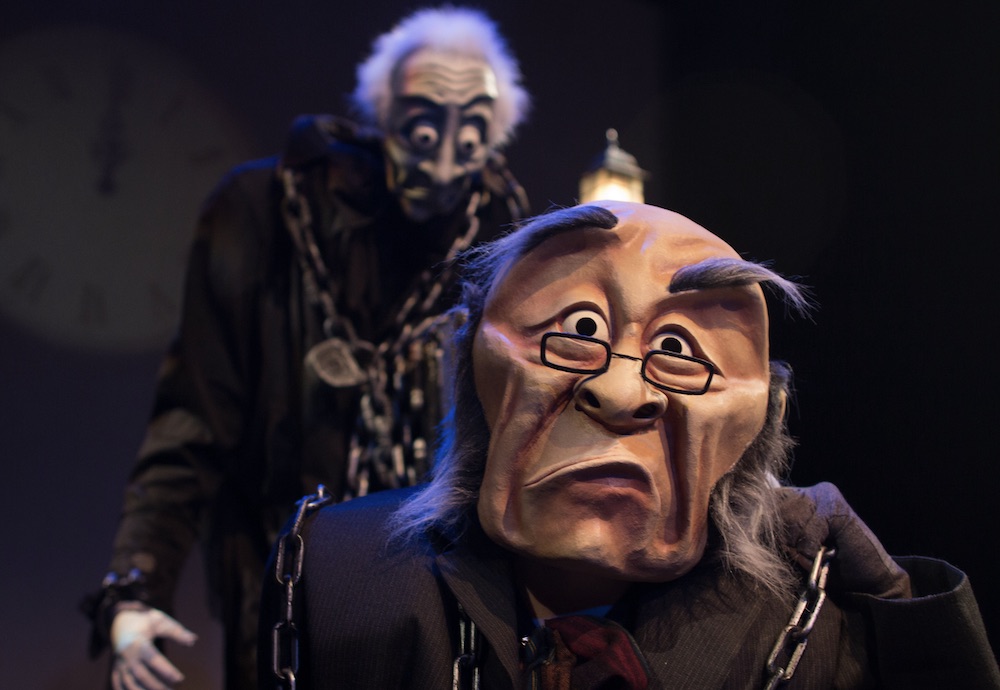
I suggest a moratorium on adaptations of A Christmas Carol. We’ve had more than enough and some of them are good.
In this variation from Victoria’s Wonderheads Theatre, there’s skill on display and some moments work but, as a whole, the evening is boring.
The medium doesn’t match the material. Dickens’s A Christmas Carol is a critique of avarice, but it’s also a portrait of redemption. Guided through the night by one dead colleague and three spirits of Christmas, Ebenezer Scrooge goes through the equivalent of some very challenging therapy; his ordeal releases his suppressed compassion.
This emotional complexity is difficult — too difficult, it turns out — to convey in Wonderheads’ wordless format.
In A Wonderheads Christmas Carol, the actors wear huge masks that cover their whole heads, so they don’t speak. Although there are some projections that use language, virtually all meaning is conveyed physically, and the result is that Dickens’s story gets so boiled down that its resonance almost completely disappears.
We never meet Fan, Scrooge’s beloved sister, for instance, so we never feel how deeply he mourned her death or understand how that death hardened him. As a result, we miss the implications of Scrooge’s refusal to spend Christmas with his nephew Fred, Fan’s son and Scrooge’s sole remaining connection to his family. We don’t see Fred, his wife, and his friends celebrating Christmas together either, so we don’t understand in visceral terms the happiness from which Scrooge has isolated himself.
And that’s true of the entire Wonderheads version of the story. There are just four characters and no broader sense of society at the Christmas party hosted by Scrooge’s former employer, Fezziwig. There’s no depth in the central relationship between Scrooge and his employee Bob Cratchit.
Because there’s virtually no social or psychological resonance, Scrooge’s redemption, his conversion, carries virtually no weight. In the 1953 film version, actor Alistair Sim’s Scrooge experiences ecstatic transcendence. The Wonderheads Scrooge does a little jig. That’s it. There’s a minor release because there’s only been minor pressure.
But I did say moments work. The Ghost of Christmas Yet To Come is genuinely scary: an enormous figure, it has the beak of a vulture hidden in its cowl, and the claws of a demon. The design of Marley’s ghost is wonderfully surprising. And Bob Cratchit’s interactions with Tiny Tim, who is presented as a puppet, are touching: embraced by his dad, Tim pats his father’s head.
Technically, the evening is tight. There are several sound cues, for instance, in which the volume changes when doors and windows are opened and closed. And there are all sorts of projections. These cues are so tightly executed that stage manager Katerina Sokyrko deserves our thanks.
The costumes (Hannah Case and Hannah Ockenden), lighting (Hina Nishioka), and masks (Andrew Phoenix and Kate Braidwood) are impressive.
The performers (Kate Braidwood, Emily Case, Pedro M. Almeida-Siqueira, and Chelsea MacEwan) are all physically precise.
So there’s skill. But the heart of the story gets lost. And, if we can’t connect with the heart, why should we keep watching? I grew so defeated that, in my head, I started counting the scenes that I knew we still had to get through.
A WONDERHEADS CHRISTMAS CAROL Based on A Christmas Carol, by Charles Dickens. Adapted and directed by Andrew Phoenix and Kate Braidwood. A Wonderheads production. At the Arts Club’s Olympic Village Stage until December 14. (Tickets and information)
PHOTO CREDIT: (Photo of Marley and Scrooge by Daryl Turner. Mask design by Kate Braidwood)
THERE’S MORE! You can get all my current reviews PLUS curated local, national, and international arts coverage in your inbox FREE every week if you subscribe to Fresh Sheet, the Newsletter. Just click that link. (Unsubscribe at any time. Super easy. No hard feelings.) Check it out.


0 Comments