
Ambitious. Meditative. I loved it.
The end of greatness is a cosmological concept that, in the words of writers Veda Hille and Maiko Yamamoto, theorizes “the point in the universe where everything stops being unique and starts being repetitive.” As I understand it, this happens because the laws of the universe are constant and there can only be so many variations. We’re talking a large observational scale, mind you, like 300 million light years.
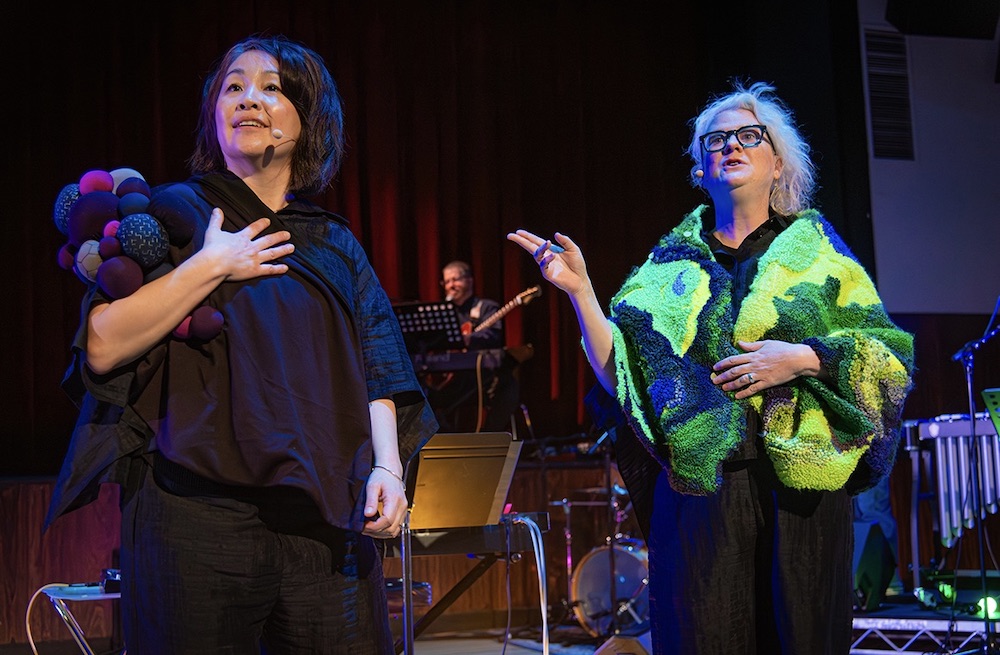
In End of Greatness, which Hille and Yamamoto also perform, they use this concept as a jumping-off point for a consideration of scale and interconnection. Singing, chatting, and telling stories, they delight in the relatively small scale of moss and mushrooms, including the single-celled ancestor we share with the latter. And they explain the universe as a well-mixed cake in which the cherries are evenly distributed.
I loved all this because it’s transcendent.
The show itself is extremely associative, so the most efficient way of evoking my experience with End of Greatness might be to offer a couple of analogies.
Think of the view the Artemis II crew had of Earth as it rose from behind the moon: at that distance, you can’t see the political divisions, the strife, but you get a breathtaking — and, the astronauts all say — life-changing look at the incredible, unique, unlikely beauty of our planet. And being reminded of that scale is a relief in a way, right? Trump is still a ridiculously dangerous asshole and, in the vastness of even near space, he disappears.
End of Greatness offers relief — and wonder. Years ago, when I was doing yoga all the time, I was prone to near-panic during savasana, the pose of the dead, the relaxation at the end of the class when you’re supposed to just let everything go. When I closed my eyes and relaxed the muscles at the base of my skull, I would go into the whirling pit of hell — as if I was drunk and the room wouldn’t stop spinning.
Then my yoga teacher said, “You can open your eyes if you need to.” As soon as I had that permission, I went so deep inside myself I couldn’t tell if I was going up or down, if I was experiencing myself on a cellular or universal level. End of Greatness allowed me to peek through that same door.
It’s a meditation that’s enabled in great part by the warmth and playfulness shared by the creator/performers, who are friends in real life. Yamamoto starts the show by saying things to the audience like, “I value your glasses”, “I value that you took the time to be here”, and then, to her collaborator, “I value you, Veda. I really value you.” And Hille replies, “I value you, too, Maiko. I just don’t want to talk about it.”
In one of the loveliest evocations of vastness, they remind us about Voyagers 1 and 2, the space probes that were launched in 1977, with an expectation that their journeys might last five years. Now, 49 years later, they’re still traveling and we’re still in communication with them. Movingly, the Voyagers contain messages to other civilizations they might encounter, including a recording of Glenn Gould playing Bach, “and other things people in the 70s thought were important.”
The Norse myth that Hille shares from her heritage is told partly through song and, like many other elements in the evening, it’s supported by black-and-white animation that’s projected on a screen that takes up the whole proscenium. At various points in the evening, we’re immersed in wild scribbling, jaunty waves, or snow. Geoffrey Farmer gets the credit for visual design.
In another texture, Yamamoto and Hille open big, white storybooks and, in the breathless cadences of childhood, relate a supposed Japanese folktale about an elderly couple who find a three-inch baby inside a mushroom cap. To me, this sounds a lot like the tale of Momotarō, the Peach Boy, repurposed, but I’m not complaining; the mushroom-princess version raises the question of mortality. How do our tiny lives fit into the vastness?
There is no strong central narrative in End of Greatness. With less intriguing material and less successful sensuality, this might have driven me nuts. But I was so into the philosophical and textural grooves of The End of Greatness that I was delighted to simply float, suspended, carried along, in part, by Hille’s spacey music — as played by Hille, Yamamoto, and musicians Thom Gill and Julia Chien.
I’ve only spoken to two other people who’ve experienced this show, and they both fell asleep. So fair warning: this much associativity may not appeal to all tastes. But, in this instance, it definitely appealed to mine.
If you’re feeling curious, I encourage you to take the leap into The End of Greatness.
END OF GREATNESS by Veda Hille and Maiko Yamamoto. A Theatre Replacement production presented by The Cultch. Running in The Cultch’s Historic Theatre until April 19. Tickets and information.
PHOTO CREDIT: Maiko Yamamoto as an expressive mushroom and Veda Hille as a more self-contained moss. (Textile design by Hitoko Okada. Photo by Chelsey Stuyt.)
THERE’S MORE! You can get all my current reviews PLUS curated local, national, and international arts coverage in your inbox FREE every week if you subscribe to Fresh Sheet, the Newsletter. Just click that link. (Unsubscribe at any time. Super easy. No hard feelings.) Check it out.




0 Comments