
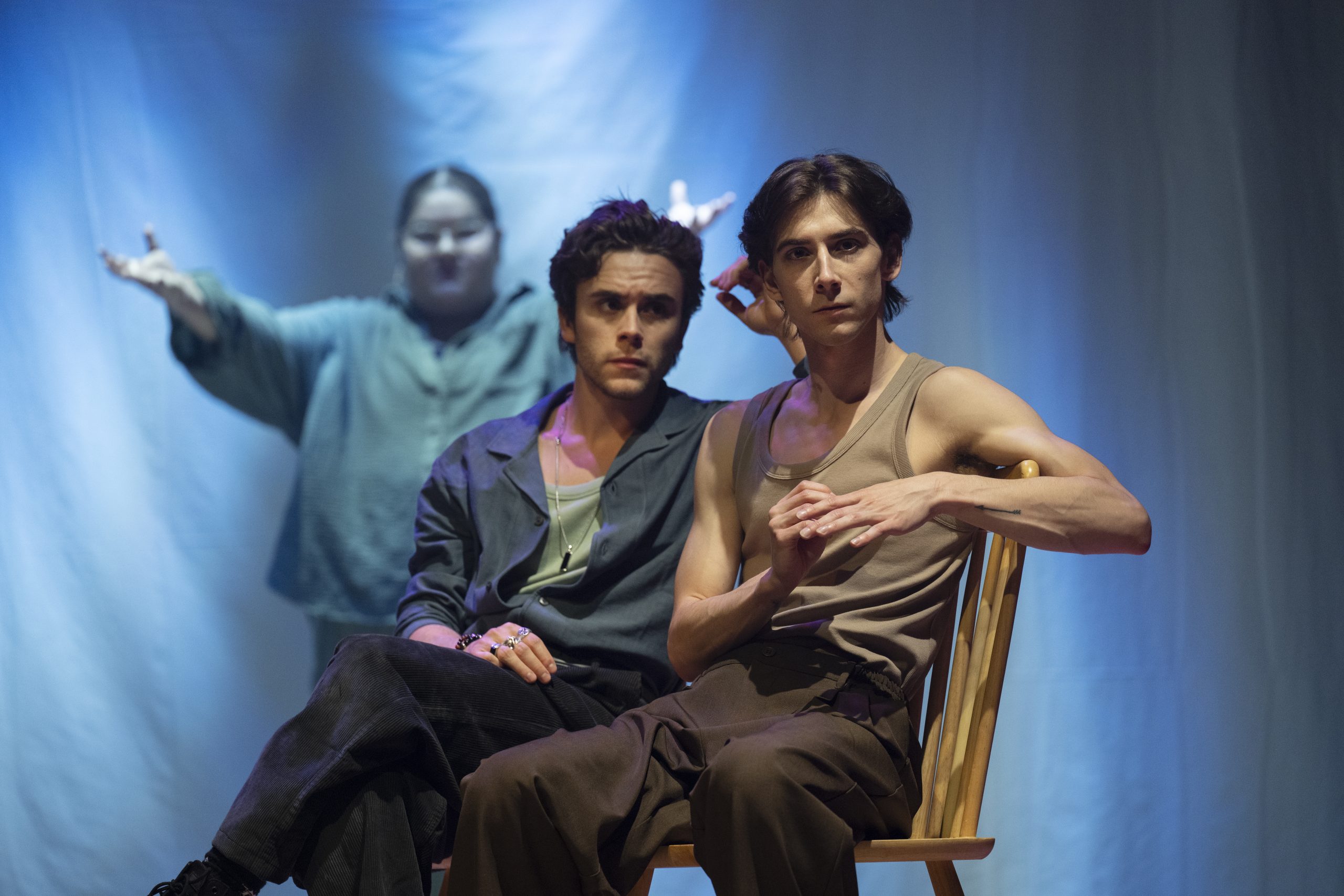
After a quick synopsis, I’m going to talk about the things I love. There are lots of them. There will also be nuance, but this review is not going to take a sharp negative turn.
As I see things, writer/director/composer/lyricist Cory Payette’s new musical On Native Land is his most fully realized theatrical project to date — and that’s saying something, given his successes with Les Filles du Roi (book and lyrics by Payette and Julie McIssac) and Children of God.
On Native Land explores the twin themes of Indigenous title and Indigenous identity: land and self.
Land becomes the narrator. She introduces us to Blood, an Indigenous singer/songwriter on the cusp of commercial success, and Chief, an elder trying to defend Indigenous land rights —while also negotiating the purchase of private property.
Payette’s storytelling is cross-braced by multiple levels of narrative tension that keep things poppin’.
Chief’s story is complicated by the presence of her lawyer, Rielle, an Indigenous professional working within the colonial legal system. In court, where Chief’s private purchase is being contested, Rielle struggles to control her client’s outbursts, which are expressions of Chief’s fury at having fought a lifetime’s worth of legal battles in a system that’s stacked against her.
Rielle is also negotiating a crazy-making cultural divide. As she explains to Chief, every time she enters the courtroom, she feels she needs to leave part of herself outside the door.
Underlying all this, of course, is the tension between Indigenous land rights and colonial exploitation of the land.
Blood’s story is complicated by the arrival of his settler boyfriend, Jakob, and by Blood’s refusal to answer media questions about which band he’s from. This is where, as a creator, Payette becomes outspoken — and things get very interesting to me. Blood doesn’t want to answer discuss his Indigineity because he sees the questions as a strategy for undermining Indigenous identity, part of a larger project of dismissing Indigenous culture — and, implicitly (to me at least), land claims. Payette’s lyrics include the line, “When we attack one person’s identity, we attack us all.” And his lyrics question Indigenous participation in the free-for-all of identity politics. Indigenous folks could resist delegitimization, the lyrics contend, “And we say, ‘Go ahead. Pick us apart.’”
I don’t want to oversimplify this dynamic as it’s presented in On Native Land: Blood and Chief start out on opposing sides of the debate; Jakob sees Blood’s refusal to be more forthcoming and articulate about his analysis as boneheaded; and, to be clear, as a settler and outsider to this discussion, I have no desire to downplay its complications and deeply felt implications for Indigenous people. I will say, however, that, within this fraught and painful debate, Payette’s take strikes me as, at the very least, an expression of compassion for some contested figures — and an embattled population.
So. Narrative and thematic tensions.
Precisely and passionately played by musicians Dean Edward Thiessen, Chris Fraser, Emilio Suarez, and Sarah Ho, Payette’s score — harmonically layered, fundamentally pop in its sensibility, but with Indigenous elements — also drives the evening, as does Payette’s work as a director, especially as he moves his large cast around Alaia Hamer’s gorgeous set. That set is so subtle in its creamy tones that the overall effect becomes dramatic. There’s also plenty of drama in Jonathan Kim’s lighting design: in a repeated effect, bright lights suddenly sculpt tableaux, then snap to black.
And, as I see things, there are some problems.
Although this project’s tensions keep theatricality on the boil, they also become relentless in Act 1. For characters to learn anything — and take us along for the ride — they need to experience successes as well as failures as they strive to reach their goals. Chief’s storyline includes a series of strategies at least but, as Blood simply repeated his blunt refusal to reveal his affiliations or, unapologetically, his lack of them, I started to side with Jakob and view Blood as boneheaded — and boring.
There’s more relief in Act 2 but, as things start to fall into place, they fall so suddenly that I was left wanting more. The first meaningful success is also the end of the story. And there’s a thread about addiction that’s so perfunctory it’s almost not worth including. Yes, On Native Land is a parable of sorts and simplification is inevitable, but addiction goes so deep that this treatment, though moving, is also so offhanded that it’s less than satisfying.
Stephanie Kong’s naturalistic costume designs work just fine but there are times in Blood’s storyline that her designs go way over the top. Kong clothes the guests at a gala reception, for instance, as if they’re demons at a camp vampires’ ball — all swirling black fabric and glittering sequins. I understand that the gathering has a sinister edge, but surely there’s a more sophisticated way to express that. (I also understand that the choices that look wacky to me are, at least in part, Payette’s responsibility.)
Performances.
Wahsontiio Kirby, a member of the Mohawk Nation of Kahnawà:ke, is a knockout playing Land and several other characters. Delivering Payette’s cleverly written introduction as Land, they are so charming and confident that they instantly establish themself as a performer you can trust. They also possess a warmly powerful singing voice, especially in their lower register. Amanda Trapp sings beautifully as Rielle, the lawyer, and she delivers a subtle characterization. In the underwritten role of Rielle’s law partner, Elliot, Jakob Woike shows off a pleasing softness his upper register. And, as Chief’s daughter, Gracie, Jenna Brown offers a passionate, credible characterization — and crystalline soprano.
It’s a strong ensemble. Zac Bellward sings well as Jakob, but, playing Blood, Dustyn Forbes struggles with the high, wailing passages Payette favours: his voice often grates up there. That said, as actors, Bellward and Forbes make the storyline they inhabit very moving in Act 2.
Taninli Wright brings such honesty and depth to her work as Chief that her presence becomes an emotional cornerstone of the evening.
The storytelling in On Native Land also includes a dance that features a male/male pas de deux performed by Nathan Coburn and Jera Wolfe, the evening’s choreographer. I found some elements of the pas de deux repetitive, but the execution is so exquisite that I sank into it.
Some quibbles but so much to celebrate. On Native Land is another triumph for Payette. That means it’s also yet another triumph for Indigenous storytelling and representation.
ON NATIVE LAND Written and directed by Cory Payette. Music and lyrics by Corey Payette. Produced by Raven Theatre and Urban Ink, and presented by The Cultch. Running at the York Theatre until April 19. Tickets and information.
PHOTO CREDIT: Watched over by Land (Wahsontiio Kirby), Jakob (Zac Bellward) and Blood (Dustyn Forbes) get serious. (Lighting by Jonathan Kim. Photo by David Cooper.)
THERE’S MORE! You can get all my current reviews PLUS curated local, national, and international arts coverage in your inbox FREE every week if you subscribe to Fresh Sheet, the Newsletter. Just click that link. (Unsubscribe at any time. Super easy. No hard feelings.) Check it out.

0 Comments