
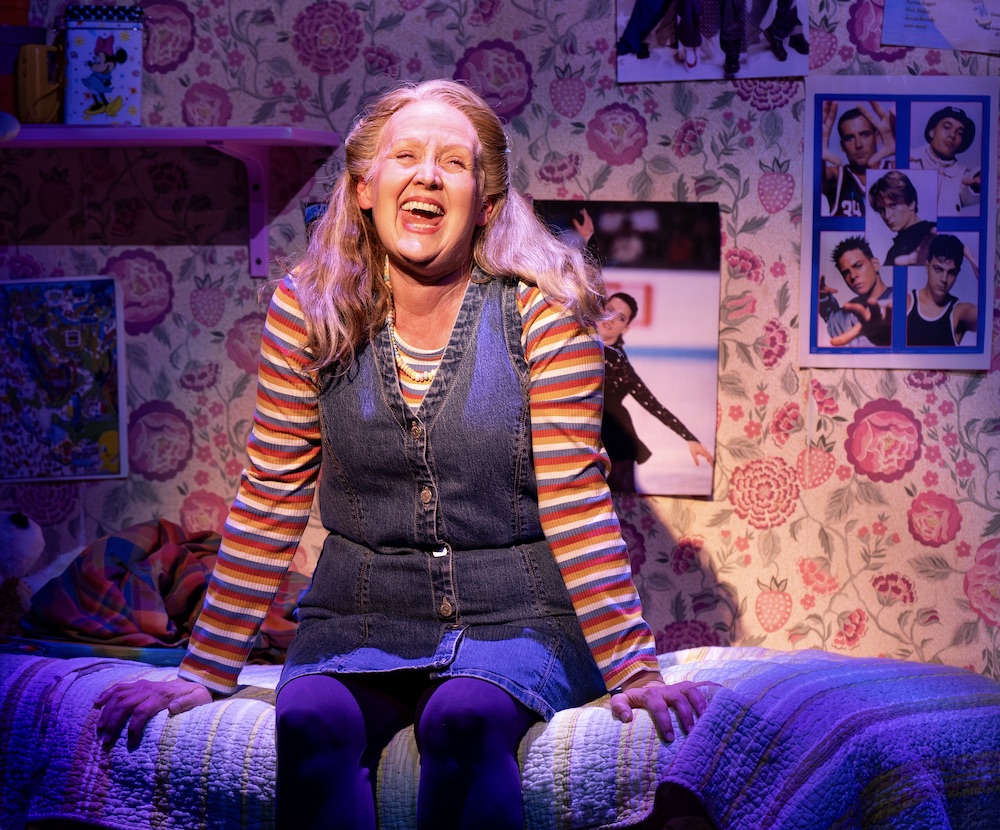
I was not completely charmed by Kimberly Akimbo, which, given the musical’s popularity, might be a sign of sociopathology — or terminal jadedness. In my defense, although the whole didn’t sweep me away, I did enjoy substantial components of this Arts Club production.
David Lindsay-Abaire’s book, which he based on his earlier play, is about the titular teenager’s attempt to negotiate what will probably be the last year of her life. Kimberly Levaco, who’s 16, has an “extremely rare” — and highly fictionalized — disease that causes her to age four to five times faster than normal. (The real-life illness progeria has much more devastating symptoms than Kimberly’s dramatically convenient version: Kimberly just looks old for her age.)
Because this is a musical, Kimberly is plucky, despite her wildly dysfunctional family. Her mother Pattie is a hypochondriacal narcissist, and her dad Buddy is an alcoholic and perpetual disappointment. They both say criminally insensitive things: when Kimberly, who’s interested in a boy for the first time, tries on a little make-up, Buddy laughs, “You look like Nana at her wake.” Then there’s Kimberly’s brassy — and criminal — Aunt Debra, who sucks Kimberly and her friends into a mail-fraud scheme.
Theatrically, the strategy is obviously to wring laughs from audacity (“Oh, those wacky Levacos! Mail fraud!”) but Kimberly is a child, and all children deserve better than this. Because I felt contempt for how these characters treated Kimberly and her friends, because their fucked-up-edness wasn’t developed with enough nuance to allow me to feel real empathy with them — and because I didn’t find any of their selfishness funny — I had no investment in big swaths of the show.
I was, however, absolutely up for the tenderness. Kimberly, who’s just arrived at a new school and is nervous about it, makes friends with a nerdy guy named Seth, who likes to solve puzzles. In their first duet, “Anagram”, Seth turns “Kimberly Levaco” into “Cleverly akimbo” and she muses, “I wonder how you see the things you see/ With a change of perspective/ Nothing’s defective/ I wonder what you see/ When you look at me.” In Lisa Horner’s emotionally transparent performance, it’s so moving to see Kimberly opening to the possibility of a real friendship.
In its innocence and lack of judgment, Jason Sakaki’s Seth meets Horner’s Kimberly every step of the way. Sakaki aces his comic rhythms, including in an exchange in which Seth offers to kiss Kimberly “if that’s what you want.”
Then these two start hanging out with the four members of the school’s show choir — also outcasts, of course. For me, this new friend group felt like high-school Drama Club all over again: solidarity of the rejected!
This might be a good time to mention that everybody in this production can really sing. Tesori’s melodies are tricky, but Horner’s voice — powerful, warmly textured and perfectly pitched over a wide range — flies through them. Josh Epstein’s vocal performance as Buddy is also particularly impressive: in his phrasing and vocal eccentricities, including his sustained Rs, — Epstein is clearly singing in character, which is so welcome.
I had more trouble with Steffanie Davis’s Pattie. There’s no doubt about it: Davis can sing: she’s got the range, she’s got the power. But she’s overacting or, to put it another way, too much of her work feels premeditated. This applies to both Davis’s performance of songs and her delivery of dialogue. When Davis is speaking and she suddenly drops her voice several notes to hit the punchline, it feels calculated. And, when she’s singing, it often feels like she’s straining for emotional effect, but she’s not allowing herself to be vulnerable enough to fully — and affectingly — inhabit the emotion.
Madeleine Suddaby is the Queen of the Belters, and, playing Debra, she gets plenty of opportunities to belt.
I have no doubt that there’s more room for subtlety than Kimberly Akimbo is getting under Ashlie Corcoran’s direction.
As things stand, in this mounting, I enjoyed Act 2 more than Act 1: the second act acquires more emotional depth — and Horne fearlessly explores that depth.
Still, I am not yet a fan of the musical. Neither, I’m guessing, are the four people who had been seated near me but did not return after the intermission.
KIMBERLY AKIMBO Book and Lyrics by David Lindsay-Abaire, music by Jeanine Tesori, based on the play by David Lindsay-Abaire. An Arts Club production directed by Ashlie Corcoran. Running at the Stanley Theatre until May 3. Tickets and information.
PHOTO CREDIT: (Photo of Lisa Horner by Moonrider Productions. Set by Pam Johnson. Costume by Stephanie Kong)
THERE’S MORE! You can get all my current reviews PLUS curated local, national, and international arts coverage in your inbox FREE every week if you subscribe to Fresh Sheet, the Newsletter. Just click that link. (Unsubscribe at any time. Super easy. No hard feelings.) Check it out.




You are truly out to pasture. Pls stop thinking your opinions are gospel. Not everything will appeal to a washed up old failed playwright