
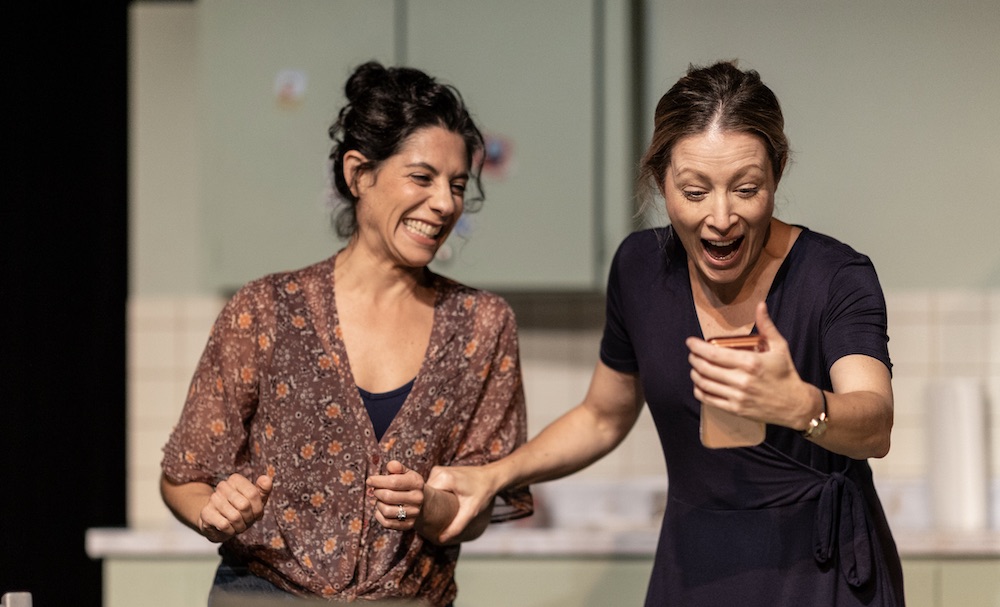
Despite its subject matter, which might sound daunting, Mary Jane is not depressing. In fact, it’s often very funny. It’s so ambitious that it will open you up as a human being. And Mitch and Murray Productions’ presentation of the script does a superb job of embodying the play’s riches.
In so many ways, playwright Amy Herzog’s text feels elemental. The title character’s name is so simple she might as well be called Jane Doe or Everywoman.
And there are primal forces at work in her story. Mary Jane is a single mom whose son Alex, now three, was born at 25 weeks with a devastating constellation of challenges, including cerebral palsy, a seizure disorder, and chronic lung disease. Mary Jane’s devotion to Alex is heroic and relentlessly upbeat. (We never see Alex, but we feel his presence in the alarm that goes off in the one-bedroom apartment he shares with his mom every time something goes wrong with his vitals.)
So, yes, this is all tough. But the script is also about the overlapping networks of compassion that Mary Jane co-creates with the women around her.
In this Vancouver production, Kate Craven is playing Mary Jane and four other actresses double up to play the remaining eight roles. Although there’s no intermission in the 90-minute runtime, there are two discernible acts.
At the top of Act 1, we meet Ruthie, Mary Jane’s super, who’s played by Jennifer Clement, and the evening gets off to a rolling start. In a way, Ruthie is a cluster of typically masculine attitudes, including her predilection for offering advice. “You seem to be somebody who’s carrying a lot of tension in your body,” she tells Mary Jane after trying but failing to unclog the kitchen sink. Holding stress, she says, is “how my sister got cancer” — although, Ruthie is quick to point out, her sister dealt with her cancer by doing tai chi.
Clement’s Ruthie is broader than any other characterization in this production, but it feels emotionally true and it’s so rewarding that I don’t care.
Because she so ably inhabits the script’s central tension, Kate Craven’s portrait of Mary Jane is like a spring that feeds the entire evening. That tension is about an optimism that can lead to dangerous half-blindness — Mary Jane is deliberately less concerned about Alex’s spiking temperature, for instance, than the homecare nurse Sherry is — but is also, albeit paradoxically sometimes, an essential strategy for survival.
That’s a lot of tension to hold and, when it’s broken by release or recognition, many of the script’s most moving moments are born: when Mary Jane allows herself to remember “I used to hike and get high in the mountains” and Craven’s eyes fill with tears, for instance; or when Mary Jane’s pep talk to Brianne, who’s the new mom of a disabled child, is so overwhelming that Brianne breaks down in tears and Mary Jane stops in her tracks, realizing what she’s done.
In Act 2, the setting changes from Mary Jane’s flat to a hospital ward to which Alex has been admitted. In David Roberts’s simple, masterful set, this change is facilitated by the rearrangement of one of its central features: emergency-room curtains.
Thematically, the play takes a turn towards profundity.
This turn is preceded by a passage of inevitable exhaustion. Crystal Balint, who has been excellent as the warm, no-nonsense Sherry in Act 1, becomes Dr. Tyrone in Act 2. In an extended conversation in which Mary Jane and Tyrone never quite explicitly discuss Alex’s chances of survival, both characters are drained and frustrated with each other.
Then an Orthodox Jewish woman named Chaya, who also has a child in intensive care, breaks open a passage to another level. Ending up in intensive care for weeks always feels like the worst possible outcome, she says, but it’s also “a relief” because “it’s real.”
Advah Soudack, who’s Brianne in Act 1, is Chaya in Act 2, and her performance is remarkable. There’s a deadpan humour in it that’s a giddy release: “You’re not married?” Chaya says to Mary Jane. “That’s awful.” But there’s also an awful, awesome clarity in the straightforwardness of Soudack’s delivery as Chaya.
This turn towards embracing the overwhelming unpredictability of the universe goes further in a scene between Mary Jane and a Buddhist chaplain named Tenkei (Clement again, this time in a beautifully restrained evocation of internality).
Celeste English’s lighting — the trippiness of Mary Jane’s migraine-induced auras, the disorienting brightness of the hospital glare — is evocative.
Sewit Eden Haile, who rounds out the cast as Sherry’s niece Amelia in Act 1 and a music therapist named Kat in Act 2, also delivers strong portraits and knows how to get laughs out of straightforward delivery.
In creating their own palpable network of mutual support, the members of this cast form a living embodiment of the script’s theme of compassion.
Herzog’s story, which is about the humble and everyday, is heroic and huge.
MARY JANE by Amy Herzog. Directed by Aaron Craven. Presented by Mitch and Murray Productions. Running at Studio 16 until November 1. Tickets and information.
PHOTO CREDIT: (This photo of Advah Soudack, left, as Brianne and Kate Craven as Mary Jane is by Shimon Photo.)
ACTIVATE YOUR FREE SUBSCRIPTION TO THE FRESH SHEET NEWSLETTER AND GET MY LATEST REVIEWS — PLUS ESSENTIAL GLOBAL ARTS COVERAGE — STRAIGHT TO YOUR INBOX EVERY WEEK. UNSUBSCRIBE ANYTIME.



0 Comments